Twenty-four letters, α to ω
Greek alphabet
The twenty-four letters of the Greek alphabet, with the name, the reading, the transliteration and the use of each, from mathematics to physics, and a trainer for learning to recognise them. Philosophy, written with them, is φιλοσοφια.
Where it comes from
The Greek alphabet is the oldest alphabet with vowels still in use. The Greeks assembled it around the eighth century before the common era from the Phoenician script, a system of consonants, and the change they made was to reuse the Phoenician letters for sounds Greek lacked as letters for the vowels. That decision gave the world the complete alphabet: from it came Etruscan, Latin, Coptic, Gothic and, by another road, Cyrillic.
The shapes in the table are the lowercase letters, born in the Middle Ages from the fast hand of Byzantine copyists; the capitals are the old forms of stone inscriptions. That is why some letters have two such different drawings, sigma even three, and why the capital of a Greek letter often looks like a Latin letter while the lowercase does not.
The use of Greek outside Greece is almost entirely scientific. Mathematics took the letters as symbols because the Latin alphabet was already spent on variables: pi for the ratio of the circle, sigma for a sum and for the standard deviation, delta for change, lambda for wavelength. Anyone who studies an exact science ends up reading Greek without having learned it, one letter at a time.
How it is read
The reading on this page is that of modern Greek, with a note on the ancient reading where the two part ways. The differences that surprise most: beta sounds like V, eta and upsilon sound like I, and chi is a throat sound English lacks. The transliteration in Latin letters, the column of the table that says how to write the letter with our alphabet, is the convention used in dictionaries and in the spelling of Greek names, and it is what the trainer accepts as an answer, with the commonest variants.
A transliteration is not a translation. Writing a name in Greek with the table swaps each sound for a letter, which gives a result a Greek can read, but not the name a Greek would write: sounds English has and Greek lacks, such as J, have no letter.
The table
The twenty-four letters with the transliteration and the English name.
| Transliteration | Letter | Name |
|---|---|---|
| a | α | alpha |
| b | β | beta |
| g | γ | gamma |
| d | δ | delta |
| e | ε | epsilon |
| z | ζ | zeta |
| ē | η | eta |
| th | θ | theta |
| i | ι | iota |
| k | κ | kappa |
| l | λ | lambda |
| m | μ | mu |
| n | ν | nu |
| x | ξ | xi |
| o | ο | omicron |
| p | π | pi |
| r | ρ | rho |
| s | σ | sigma |
| t | τ | tau |
| u | υ | upsilon |
| ph | φ | phi |
| ch | χ | chi |
| ps | ψ | psi |
| ō | ω | omega |
The twenty-four letters
αaalpha
- Drawing

- Written
- a
- Unicode
U+03B1
The first letter, and the origin of the Latin A. Mathematics uses alpha for angles and for the first coefficient in a fit; physics for the alpha particles of radioactivity; astronomy for the brightest star of a constellation, as in Alpha Centauri. It sounds like the A in father, and never like the A in cake.
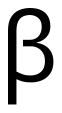
βbbeta
- Drawing
- Written
- b, v
- Unicode
U+03B2
The second letter and the source of the Latin B. In modern Greek it sounds like V, and so Vasilis and Basil are the same name. It marks the beta release of software, the second-brightest star of a constellation, and in statistics the slope of a regression line and the type II error rate.
γggamma
- Drawing

- Written
- g
- Unicode
U+03B3
Gamma, the source of both C and G in Latin. Gamma rays are the most energetic radiation there is, and the gamma function extends the factorial to numbers that are not whole. In imaging, gamma describes how brightness is compressed. It sounds like a hard G, softened to a breathy sound before some vowels in modern Greek.
δddelta
- Drawing

- Written
- d
- Unicode
U+03B4
Delta, from which the Latin D descends. The capital is a triangle, and that is how mathematics writes change: delta t, delta T. A river delta takes its name from the triangular mouth of the Nile. The lowercase is the small quantity of an epsilon-delta proof and the variation of the calculus of variations.
εeepsilon
- Drawing

- Written
- e
- Unicode
U+03B5
Epsilon, the short E of ancient Greek, as opposed to eta, which was long. In analysis it is the arbitrarily small positive number of every limit definition; in computer science it is the empty string. The name means plain E, coined to tell it apart from a diphthong that had come to sound the same.
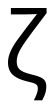
ζzzeta
- Drawing
- Written
- z
- Unicode
U+03B6
Zeta, the sixth letter, from which the Latin Z takes its shape and its name. The Riemann zeta function, written with it, holds the most famous open problem in mathematics. In ancient Greek it sounded like ZD or DZ; today it sounds like the Z in zebra.
ηēeta
- Drawing

- Written
- ē, ee
- Unicode
U+03B7
Eta, the long E of ancient Greek, read today as an I sound. That is why so many Greek words have an I in modern pronunciation where the spelling has an E. In physics eta is efficiency; in chemistry, viscosity. It differed from epsilon in length, not in quality, a distinction only the ancient ear made.
θththeta
- Drawing

- Written
- th
- Unicode
U+03B8
Theta, the TH of think, a sound English has and most European languages lack. In geometry it is the angle par excellence, the one that turns in polar coordinates; in statistics, the unknown parameter to be estimated. The drawing, a circle with a bar, is unchanged after two and a half thousand years.
ιiiota
- Drawing

- Written
- i
- Unicode
U+03B9
Iota, the smallest letter of the alphabet, a single stroke. Hence the expression not one iota, already in the Gospel of Matthew, meaning not the least bit. It sounds like the I in machine and is the origin of both I and J in Latin, which separated only centuries later.
κkkappa
- Drawing

- Written
- k, c
- Unicode
U+03BA
Kappa, the source of K. Greek uses it for the sound Latin came to write with C, so Cicero and Kyrie use different letters for one sound. In physics kappa is curvature; in statistics, the measure of agreement between raters. It sounds like the K in kite.
λllambda
- Drawing

- Written
- l
- Unicode
U+03BB
Lambda, from which L descends, shaped like a roof in capital and a forked path in lowercase. In physics it is wavelength; in linear algebra, an eigenvalue; in programming, the anonymous function, named after the lambda calculus of Alonzo Church. It sounds like the L in lamp.
μmmu
- Drawing

- Written
- m
- Unicode
U+03BC
Mu, the origin of M, with the sound M has in every language. In lowercase it is the micro of the metric system, one millionth, and the population mean of statistics. In physics, the coefficient of friction. It is the Greek letter that appears most in engineering formulas without anyone noticing it is Greek.
νnnu
- Drawing

- Written
- n
- Unicode
U+03BD
Nu, the Greek N, and the most misread Greek letter: the lowercase looks like a Latin V. In physics it is the frequency of a wave, and the energy of a photon is read h nu. In statistics, degrees of freedom. It sounds like the N in name.
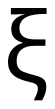
ξxxi
- Drawing
- Written
- x, ks
- Unicode
U+03BE
Xi, an X that sounds like the X in taxi, two sounds at once. The lowercase is the hardest letter of the alphabet to write by hand, three stacked curves, and physicists joke about it. In statistics it marks a random variable when X is already taken.
οoomicron
- Drawing

- Written
- o
- Unicode
U+03BF
Omicron, the short O, whose name means little O. It sounds like the O in pot and is the origin of the Latin O. It became known outside textbooks when it named a variant of the coronavirus: the health organisation was working through the alphabet and skipped the two letters before it, nu and xi, to avoid confusion with the word new and with a common surname.
πppi
- Drawing

- Written
- p
- Unicode
U+03C0
Pi, the origin of P and the most famous Greek letter, because of the number it names: the ratio of the circumference of a circle to its diameter, three point one four and infinitely many more digits. In capital it marks a product, as sigma marks a sum.
ρrrho
- Drawing

- Written
- r, rh
- Unicode
U+03C1
Rho, from which R descends, with the shape of a Latin P and the sound of an R. In physics it is density and resistivity; in statistics, the correlation coefficient. In ancient Greek it was a trilled and aspirated R, which Latin transcribed as RH in names like Rhodes and rhythm.
σssigma
- Drawing

- Written
- s
- Unicode
U+03C3
Sigma, the origin of S. In capital it is the summation sign of mathematics; in lowercase, the standard deviation of statistics, whence the phrase six sigma. It has a final form of its own, used at the end of a word, which the plain table does not separate and the page explains.
τttau
- Drawing

- Written
- t
- Unicode
U+03C4
Tau, the Greek T, with the sound of the T in top. In physics it is torque and the time constant of a circuit; some mathematicians prefer tau for the full turn, twice pi. The T-shaped cross of the Franciscans bears its name.
υuupsilon
- Drawing

- Written
- u, y
- Unicode
U+03C5
Upsilon, the Greek U, which Latin transcribed as Y and which sounds today like an I. It is the origin of both Y and V in Latin. The name means plain U, as epsilon means plain E. In particle physics it names the upsilon meson; elsewhere it is rare as a symbol, because it is too easily read as a Latin Y.
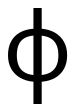
φphphi
- Drawing
- Written
- ph, f
- Unicode
U+03C6
Phi, the Greek F, with the sound of the F in fish, which Latin wrote as PH and English inherited in philosophy and photograph. It names the golden ratio, one point six and infinitely many more digits, and in physics magnetic flux and the phase of a wave. The shape is a circle cut by a vertical stroke.
χchchi
- Drawing

- Written
- ch, kh
- Unicode
U+03C7
Chi, a throat sound English lacks, close to the CH of Scottish loch, which Latin transcribed as CH in names like Christ. The lowercase looks like a Latin X, which is why X stood for Christ for centuries. In statistics, the chi-squared test.
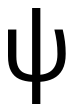
ψpspsi
- Drawing
- Written
- ps
- Unicode
U+03C8
Psi, two sounds in one letter, P followed by S, as in psychology, which comes from it: psyche, the soul. It is the trident of the table, and so names the wave function of quantum mechanics and is the symbol of psychology. It is read as psi, with the P sounded.
ωōomega
- Drawing

- Written
- ō, oo
- Unicode
U+03C9
Omega, the long O, whose name means great O, and the last letter of the alphabet, which made it a byword for the end: the alpha and the omega. In physics the capital is the ohm of electrical resistance and the lowercase is angular velocity. In modern Greek it sounds exactly like omicron.
Practise
Flashcards for recognising each letter and a reading series: it starts with five letters, and the next comes in when all the active ones are answered right nine times in ten. Progress stays in your browser.
5 of 24 signs in play. 0 of 5 learned; the next sign comes when all are.
- α a not yet
- β b not yet
- γ g not yet
- δ d not yet
- ε e not yet
Frequently asked
How many letters does the Greek alphabet have?
Twenty-four, alpha to omega, seven vowels and seventeen consonants.
How do I write a name in Greek?
Use the table: each sound is swapped for the nearest Greek letter. Sophia becomes σοφια, and read back it gives sophia. It is a transliteration, an approximation letter by letter, and not a translation; the page says so.
Why does sigma have two forms?
Because Greek writes sigma one way in the middle of a word and another at the end. The plain table carries the middle form, the one learned first; the section on the letter explains the final form and when it applies.
Is the Greek alphabet the origin of ours?
Yes, by an indirect route. The Greeks adapted the Phoenician alphabet, the Etruscans adapted the Greek and the Romans adapted the Etruscan. That is why so many Latin letters have the shape of a Greek one, and why the Greek B sounds like V and the Greek H is a vowel.
What this table does not say
This table is a modern convention, not the system as its users practised it.
- The written column is a transliteration, letter by letter; a name written with it is readable, not the form a native speaker would choose.
- Sigma has a form of its own at the end of a word, which the plain table does not separate; the letter's section says when it applies.