4 vowels and 36 syllables, 𒀀 to 𒍪
Cuneiform translator
Cuneiform explained, with the syllable signs an introductory syllabary teaches, what each writes and where it appears in the names of kings and gods, and a translator that writes a name in syllables as Akkadian scribes did with foreign names. Nabu becomes 𒈾𒁍.
The oldest writing
Writing was born in accounting. In the cities of southern Mesopotamia, around 3200 before the common era, the administrators of the temples of Uruk began recording sacks of grain and head of cattle with marks in clay, and the marks became signs, and the signs, which at first drew the thing counted, became groups of wedges pressed with the tip of a reed stylus. It is from that wedge, cuneus in Latin, that the name comes. Dried clay lasts for millennia, so hundreds of thousands of tablets are known, from receipts to poems.
The system served Sumerian first and then Akkadian, the language of Babylon and Assyria, and was adapted to Hittite, Elamite and other languages, each choosing the signs and readings it needed. A sign could stand for a whole word, the sign for sky, for king, for water, or for a syllable, and the same sign had both functions and several readings. A trained scribe read and wrote with a few hundred signs in current use; the school lists run past a thousand.
Cuneiform died in the first century of the common era, replaced by Aramaic and Greek, and stayed unreadable for eighteen hundred years. Decipherment came in the nineteenth century, starting from the trilingual inscription of Darius on the rock of Behistun, and within a few decades gave the world back the code of Hammurabi, the epic of Gilgamesh and the library of Ashurbanipal.
How a name is written
A foreign name, to an Akkadian scribe, was a sound to be broken into syllables, each written with the sign that had it among its readings. Hammurabi, the king of the law code, appears on the tablets as ha, am, mu, ra, bi, five signs, two of which this table does not carry. That is the shape of what the box above does with a modern name: it cuts the name into syllables of consonant and vowel and writes each with the sign from the table, so that Sama becomes 𒊓𒈠.
The table on this page carries the four vowels and the open syllables of consonant plus vowel that an introductory syllabary teaches, forty signs in all. That is a beginner's subset, not the syllabary: it has no H and no E syllables, so ha is missing along with the rest. Akkadian also had closed syllables, such as am, ur and ik, with signs of their own, and it is with those that a scribe would write most English names; when a name needs a syllable the table lacks, the box says which was left out instead of inventing. The result is an approximation, in the way a transcription of Hammurabi in Latin letters is an approximation, and the caveat block repeats that where it matters.
The table
The vowels and the open syllables. The third column is the sign's name in the standard lists, which for these signs is the syllable itself, written in capitals by convention.
| Syllable | Sign | Name |
|---|---|---|
| Vowels | ||
| a | 𒀀 | a |
| e | 𒂊 | e |
| i | 𒄿 | i |
| u | 𒌋 | u |
| Syllables | ||
| ba | 𒁀 | ba |
| bi | 𒁉 | bi |
| bu | 𒁍 | bu |
| da | 𒁕 | da |
| di | 𒁲 | di |
| du | 𒁺 | du |
| ga | 𒂵 | ga |
| gi | 𒄀 | gi |
| gu | 𒄖 | gu |
| ka | 𒅗 | ka |
| ki | 𒆠 | ki |
| ku | 𒆪 | ku |
| la | 𒆷 | la |
| li | 𒇷 | li |
| lu | 𒇻 | lu |
| ma | 𒈠 | ma |
| mi | 𒈪 | mi |
| mu | 𒈬 | mu |
| na | 𒈾 | na |
| ni | 𒉌 | ni |
| nu | 𒉡 | nu |
| pa | 𒉺 | pa |
| ra | 𒊏 | ra |
| ri | 𒊑 | ri |
| ru | 𒊒 | ru |
| sa | 𒊓 | sa |
| si | 𒋛 | si |
| su | 𒋢 | su |
| sha | 𒊭 | sha |
| shu | 𒋗 | shu |
| ta | 𒋫 | ta |
| ti | 𒋾 | ti |
| tu | 𒌅 | tu |
| za | 𒍝 | za |
| zi | 𒍣 | zi |
| zu | 𒍪 | zu |
The forty signs
𒀀aa
- Drawing

- Written
- a
- Unicode
U+12000
The vowel A, one of the oldest and most frequent signs in the script, which as a word sign means water. It opens every syllabary and appears in the names of gods and kings with an initial or final A. A wide sign of horizontal wedges, easy to recognise on a tablet.
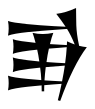
𒂊ee
- Drawing
- Written
- e
- Unicode
U+1208A
The vowel E, written with a sign of its own, which scribes used for the bare E syllables inside a word or a name. In Sumerian and Akkadian the E and the I sit close, and the same name often appears with one or the other in tablets of different periods.
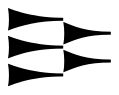
𒄿ii
- Drawing
- Written
- i
- Unicode
U+1213F
The vowel I, a sign of few wedges, used for the bare I syllable and as the first part of words. In Akkadian names it is frequent at the start, and it is one of the first readings a student memorises, because it is short and unlike any other sign.
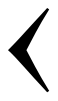
𒌋uu
- Drawing
- Written
- u
- Unicode
U+1230B
The vowel U, written with a sign that also serves for the number ten. It is the Akkadian conjunction and, so it appears between two names in a list or a treaty. To write the U of a modern name it is the sign that introductory syllabaries recommend.
𒁀baba
- Drawing

- Written
- ba
- Unicode
U+12040
The syllable BA, one of the commonest in the writing of names: it opens Babylon, which the Akkadians spelled syllable by syllable as ba-bi-lim, the gate of the god, and it appears in Zababa, the warrior god of Kish. A sign of few wedges, vertical and horizontal.
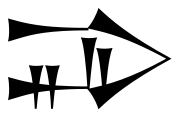
𒁉bibi
- Drawing
- Written
- bi
- Unicode
U+12049
The syllable BI, the second of Babylon and the last of Hammurabi, the king of the law code, whose name reads ha-am-mu-ra-bi. As a word sign the same sign writes beer, one of the most frequent words in temple accounting, which makes it one of the commonest signs on economic tablets.
𒁍bubu
- Drawing
- Written
- bu
- Unicode
U+1204D
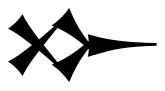
The syllable BU, which appears in Nabu, the god of scribes and of writing, whose name was written na-bu, and in the Akkadian name of the Euphrates, bu-ra-nun. An elongated sign of wedges in series, and a good syllable to start writing a name with.
𒁕dada
- Drawing
- Written
- da
- Unicode
U+12055
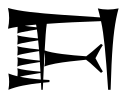
The syllable DA, frequent as part of words and names and as the suffix that marks company in Sumerian. A compact sign that beginners confuse with its neighbours; the difference is in the number of vertical wedges. It writes the DA of modern names without further note.
𒁲didi
- Drawing
- Written
- di
- Unicode
U+12072
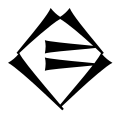
The syllable DI, which as a word sign means judgement and appears in the titles of judges and in legal texts. In names it writes the DI syllable of many Akkadian and Babylonian names. It is a sign told apart by its pair of crossed wedges.
𒁺dudu
- Drawing
- Written
- du
- Unicode
U+1207A
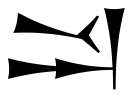
The syllable DU, which as a word sign writes the verb to go, and so stands in many royal inscriptions and accounts of a journey. It appears in Marduk, the god of Babylon, written ma-ru-du-uk on many tablets. A sign of few wedges, among the first a student meets, and it writes the DU of modern names without further note.
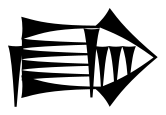
𒂵gaga
- Drawing
- Written
- ga
- Unicode
U+120B5
The syllable GA, whose word sign is milk, one of the words of the temple herds' accounting. In names it writes the GA syllable of Sumerian and Akkadian names, and it is a sign with a large wedge running across it, easy to find in a line.
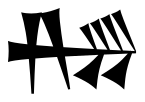
𒄀gigi
- Drawing
- Written
- gi
- Unicode
U+12100
The syllable GI, whose word sign is reed, the plant that gave the stylus and the mats, and so the very instrument the script was written with. It appears in Shulgi, the king of Ur, written šul-gi. A sign of parallel vertical wedges.
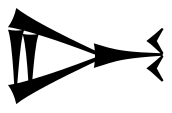
𒄖gugu
- Drawing
- Written
- gu
- Unicode
U+12116
The syllable GU, used in names and in common words; a sign with one large vertical wedge and smaller wedges around it. In introductory syllabaries it stands for the G of modern names followed by U, and the trainer accepts it as gu. On school tablets it appears early, among the first exercise signs.
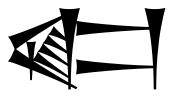
𒅗kaka
- Drawing
- Written
- ka
- Unicode
U+12157
The syllable KA, whose word sign is mouth, and by extension word and gate; the Sumerian name of Babylon, the gate of the god, opens with a gate sign of the same sound. A large sign with many wedges, and one scribes used most in compounds.
𒆠kiki
- Drawing
- Written
- ki
- Unicode
U+121A0
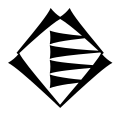
The syllable KI, whose word sign is earth and place, and which closes the name of nearly every city on the tablets as the place determinative. It appears in Enki, the god of fresh water, en-ki, and in the name of Sargon, šar-ru-ki-in. A sign with one crossed wedge, very frequent.
𒆪kuku
- Drawing

- Written
- ku
- Unicode
U+121AA
The syllable KU, used in names and as part of common words. A sign of few wedges, told from KI by the absence of the crossed wedge. To write the K of a modern name followed by U it is the sign the syllabary recommends.
𒆷lala
- Drawing
- Written
- la
- Unicode
U+121B7
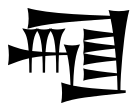
The syllable LA, frequent in Akkadian names and in Sumerian words; a sign of stacked horizontal wedges. L did not exist in Sumerian as a consonant clearly separate from R, and syllables in L belong above all to Akkadian. In modern names it writes LA without further note.
𒇷lili
- Drawing
- Written
- li
- Unicode
U+121F7
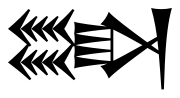
The syllable LI, which appears in Babylon in the form ba-bi-lim and in Zimri-Lim, the king of Mari whose archive of letters is one of the richest sources of the second millennium, written zi-im-ri-li-im. A compact sign of angled wedges. It writes the LI of modern names such as Lima and Livia.
𒇻lulu
- Drawing

- Written
- lu
- Unicode
U+121FB
The syllable LU, used in names and in common words. A sign of horizontal wedges and one vertical, which beginners confuse with LA; the difference is the final vertical wedge. It writes the LU of modern names, and it appears in ration lists and in the names of ordinary people on administrative tablets.
𒈠mama
- Drawing
- Written
- ma
- Unicode
U+12220
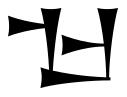
The syllable MA, which opens Marduk, ma-ru-du-uk, and appears in many Akkadian names with the suffix of possession. A large sign with a diagonal wedge crossing the horizontals, and one of the easiest to recognise. It writes the MA of modern names such as Maria and Martha, which come out short in cuneiform.
𒈪mimi
- Drawing
- Written
- mi
- Unicode
U+1222A
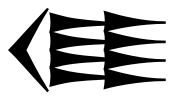
The syllable MI, whose word sign is night and black. It appears in women's names and in compound words. A sign with vertical wedges in a group, told from MU by the initial wedge. It writes the MI of modern names such as Michael; on the tablets it is rare at the start of a word.
𒈬mumu
- Drawing
- Written
- mu
- Unicode
U+1222C
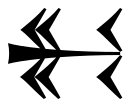
The syllable MU, whose word sign is name and year, which puts it in every dating formula and every royal inscription: the year in which the king did such a thing. It appears in Hammurabi, ha-am-mu-ra-bi, and in Sumu-abum, the first king of the dynasty of Babylon.
𒈾nana
- Drawing
- Written
- na
- Unicode
U+1223E
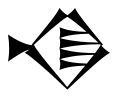
The syllable NA, which opens Nabu, na-bu, the god of writing, and Nabonidus, the last king of Babylon, na-bu-na-id. A sign with one long horizontal wedge and small wedges, frequent in theophoric names. It writes the NA of modern names such as Natalie, and is one of the signs most used by people writing their own name.
𒉌nini
- Drawing
- Written
- ni
- Unicode
U+1224C
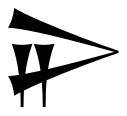
The syllable NI, whose word sign is oil, one of the commodities of the ration lists. It appears in Nineveh, ni-nu-a, the Assyrian capital, and in the Akkadian form of Nippur. A sign of parallel horizontal wedges and one vertical. It writes the NI of modern names such as Nicholas.
𒉡nunu
- Drawing

- Written
- nu
- Unicode
U+12261
The syllable NU, which as a word sign writes the negation not. It appears in Nineveh, ni-nu-a, and in many names and phrases. A sign of few wedges, one of them crossed, among the simplest to write by hand. It writes the NU of modern names and closes many negative formulas of the legal texts.
𒉺papa
- Drawing
- Written
- pa
- Unicode
U+1227A
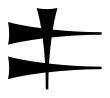
The syllable PA, whose word sign is wing and branch, and which also writes a title of a chief. P and B were confused in Akkadian writing, and one sign may carry both readings depending on the period. It writes the PA of modern names such as Paul and Patricia without further note.
𒊏rara
- Drawing
- Written
- ra
- Unicode
U+1228F
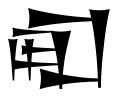
The syllable RA, one of the most frequent in Akkadian writing, which appears in Hammurabi, ha-am-mu-ra-bi, and in the name of the Euphrates, bu-ra-nun. A sign of horizontal wedges and one vertical, which scribes wrote quickly. It writes the RA of modern names such as Rachel and Raphael.
𒊑riri
- Drawing
- Written
- ri
- Unicode
U+12291
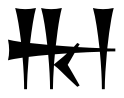
The syllable RI, which appears in Zimri-Lim, zi-im-ri-li-im, and in Assyrian names. A sign with one tall vertical wedge and smaller ones beside it; the script did not distinguish R from L systematically, so a name with an L may take an R sign. It writes the RI of modern names such as Richard.
𒊒ruru
- Drawing
- Written
- ru
- Unicode
U+12292
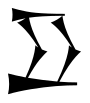
The syllable RU, which appears in Marduk, ma-ru-du-uk, in Nippur, ni-ib-ru, and in the Akkadian title of king, šar-ru. A compact sign of angled wedges, and one of the most useful for writing modern names ending in RU. It is also the RU of the Sumerians' own name in its Akkadian form.
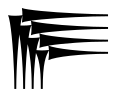
𒊓sasa
- Drawing
- Written
- sa
- Unicode
U+12293
The syllable SA, used in names and as part of common words; a sign of alternating horizontal and vertical wedges. Akkadian distinguished three S sounds, and the sign SA writes the simplest of them, the S of sun. It writes the SA of modern names such as Sarah and Samuel.
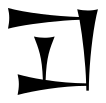
𒋛sisi
- Drawing
- Written
- si
- Unicode
U+122DB
The syllable SI, whose word sign is horn, and which appears in names and in words of accounting. An elongated sign of horizontal wedges in series, which beginners confuse with SA; count the vertical wedges. It writes the SI of modern names such as Simon and Sylvia, and appears in livestock lists with the value of horn.
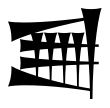
𒋢susu
- Drawing
- Written
- su
- Unicode
U+122E2
The syllable SU, whose word sign is body and skin, and which appears in Sumu-abum, su-mu-a-bu-um, and in the Akkadian name of the moon god, su-en. A large sign of vertical wedges in a group. It writes the SU of modern names such as Susan, and appears in medical texts with the value of body.
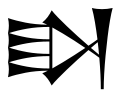
𒊭shasha
- Drawing
- Written
- sha, ša
- Unicode
U+122AD
The syllable ŠA, sounded like the SH of ship, which opens the Akkadian word for king, šarru, and the name of Sargon, šar-ru-ki-in. The trainer accepts sha and ša. A sign with one large vertical wedge and smaller wedges to its left. It writes the SHA of modern names such as Shannon.
𒋗shushu
- Drawing

- Written
- shu, šu
- Unicode
U+122D7
The syllable ŠU, sounded like the SHU of sugar, whose word sign is hand, and which closes the name of the Sumerians in its Akkadian form, šu-me-ru. The trainer accepts shu and šu. A sign of horizontal wedges and one diagonal wedge, and the sign a child learns first to write hand.
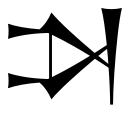
𒋫tata
- Drawing
- Written
- ta
- Unicode
U+122EB
The syllable TA, frequent in names and in common words, and the postposition of origin in Sumerian. A sign with one long horizontal wedge and vertical wedges, which scribes wrote with few movements. It writes the TA of modern names such as Tatiana and Thaddeus, and is frequent at the end of Sumerian words.
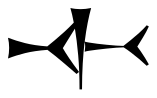
𒋾titi
- Drawing
- Written
- ti
- Unicode
U+122FE
The syllable TI, whose word sign is arrow and, by a Sumerian pun, also life, which places it in names and in wishes. It opens Tiamat, the goddess of the salt sea in the creation poem, ti-amat. A sign with one diagonal wedge. It writes the TI of modern names such as Timothy.
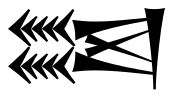
𒌅tutu
- Drawing
- Written
- tu
- Unicode
U+12305
The syllable TU, used in names and as part of words; a sign of vertical wedges and one horizontal. The Akkadian T was dental, and the sign TU serves to write the TU of modern names without further note, such as Arthur and Stuart. It appears in the names of birds in the lexical lists.
𒍝zaza
- Drawing

- Written
- za
- Unicode
U+1235D
The syllable ZA, whose word sign is bead and precious stone. It opens Zababa, za-ba-ba, the warrior god of Kish. A sign of crossed wedges, told from ZI by the number of vertical wedges. It writes the ZA of modern names such as Zara and Zachary.
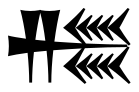
𒍣zizi
- Drawing
- Written
- zi
- Unicode
U+12363
The syllable ZI, whose word sign is life and breath, which makes it common in names and in blessing formulas. It opens Zimri-Lim, zi-im-ri-li-im, and closes Dumuzi, the divine shepherd, dumu-zi. A sign with one large vertical wedge and smaller ones. It writes the ZI of modern names.
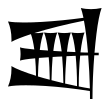
𒍪zuzu
- Drawing
- Written
- zu
- Unicode
U+1236A
The syllable ZU, whose word sign is to know, and which appears in names and in words about wisdom. A sign of horizontal wedges in series and one vertical, the last in the list of introductory syllabaries, and the Z of modern names followed by U, such as Zuleika.
Practise
Flashcards for recognising each sign by its syllable, and reading series of three to five signs. It starts with a handful of signs and adds the next sign when the active ones are firm. Progress stays in your browser.
5 of 40 signs in play. 0 of 5 learned; the next sign comes when all are.
- 𒀀 a not yet
- 𒂊 e not yet
- 𒄿 i not yet
- 𒌋 u not yet
- 𒁀 ba not yet
What this table does not say
This table is an approximation: the original system had more signs and more readings than fit a list.
- Cuneiform writes syllables, not letters; a name is built from open syllables, and sounds that close no syllable in the table are left out and reported.
- Each sign had several readings, and a scribe chose among them by context; the table shows one reading per sign.
- Writing a name with this table is what the scribes themselves did with foreign names, syllable by syllable; it is not writing the language.
Frequently asked
What is cuneiform?
The oldest writing system known, born in Mesopotamia around 3200 before the common era, made of wedges pressed into clay with a reed stylus. The name comes from the Latin cuneus, wedge. It wrote Sumerian, Akkadian, Hittite and other languages for more than three thousand years.
Is cuneiform an alphabet?
No. It is a mixed script of signs that stand for a word and signs that stand for a syllable, with hundreds of signs in use and several readings for each. The table on this page is the subset of open-syllable signs an introductory syllabary teaches, and the caveat block says what is left out.
How do I write my name in cuneiform?
In syllables, as Akkadian scribes wrote foreign names. Type in the box above: Nabu becomes 𒈾𒁍, and read back gives nabu. Sounds that close no syllable in the table are left out and the box says so; in Charles, c h r l s has no sign, and a scribe would have solved that with closed syllables the table does not carry.
How is a tablet read?
Left to right and top to bottom, in lines, from the second millennium on; the oldest tablets were written in columns. Each sign is a group of wedges, and the same shape may be read as a word or as a syllable according to context, which is the hard part of the Assyriologist's craft.
Who deciphered cuneiform?
An effort of decades in the nineteenth century, starting from the trilingual inscription at Behistun, which Henry Rawlinson copied while hanging from a cliff in Persia. Old Persian, the simplest of the three, was read first and served as the key to Akkadian; in 1857 four scholars translated the same text separately and their versions came out in close agreement.