The Morse Code Alphabet and Chart
Every character in the international Morse code, as defined by ITU-R M.1677-1, on one page: the chart, the rules behind it, and a section for each letter and digit with its rhythm, its timing, and what it is most often mistaken for. The tables are generated from the same code table the translator uses, so they cannot disagree with it.
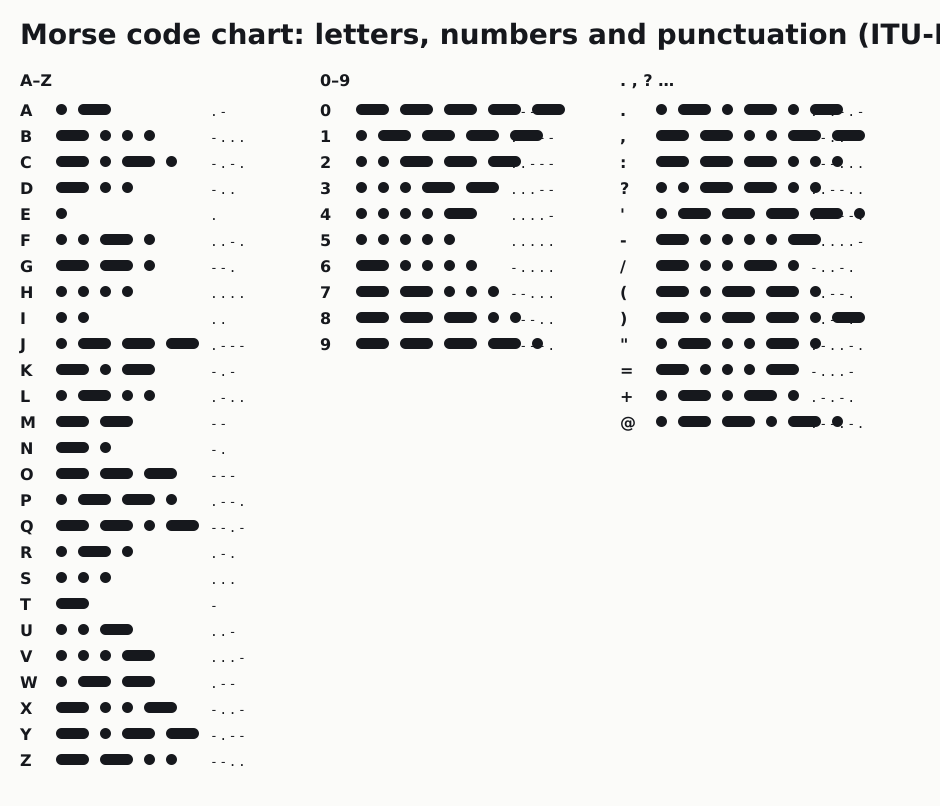
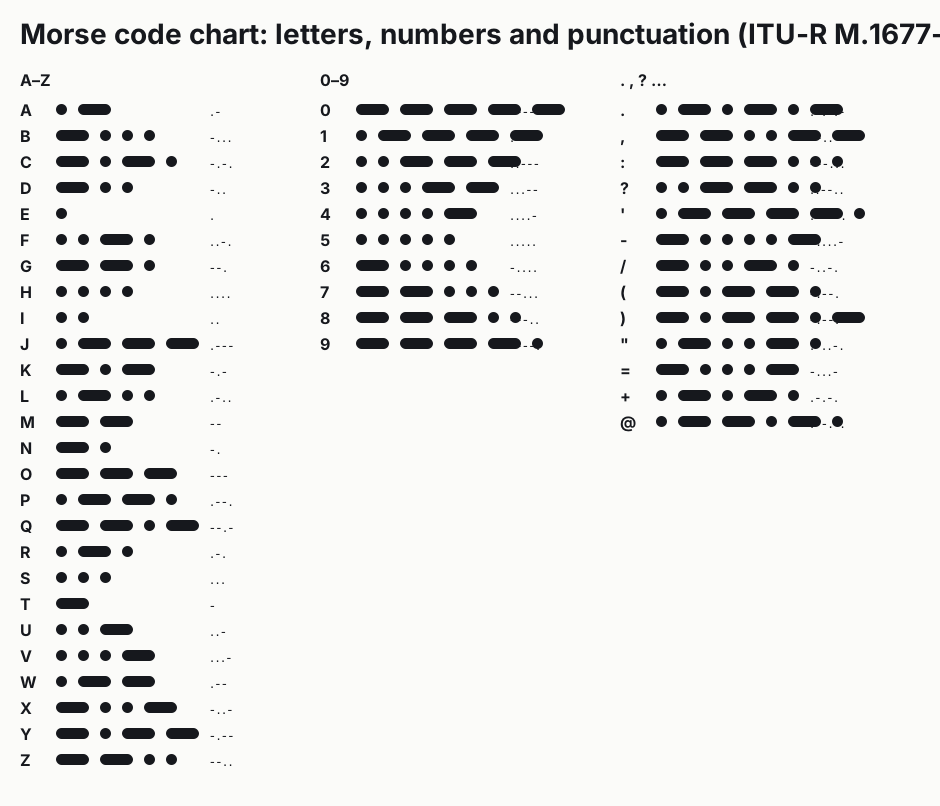
Letters
| Character | Morse |
|---|---|
| A | .- |
| B | -... |
| C | -.-. |
| D | -.. |
| E | . |
| F | ..-. |
| G | --. |
| H | .... |
| I | .. |
| J | .--- |
| K | -.- |
| L | .-.. |
| M | -- |
| N | -. |
| O | --- |
| P | .--. |
| Q | --.- |
| R | .-. |
| S | ... |
| T | - |
| U | ..- |
| V | ...- |
| W | .-- |
| X | -..- |
| Y | -.-- |
| Z | --.. |
Numbers
| Character | Morse |
|---|---|
| 0 | ----- |
| 1 | .---- |
| 2 | ..--- |
| 3 | ...-- |
| 4 | ....- |
| 5 | ..... |
| 6 | -.... |
| 7 | --... |
| 8 | ---.. |
| 9 | ----. |
Punctuation
| Character | Morse |
|---|---|
| . | .-.-.- |
| , | --..-- |
| : | ---... |
| ? | ..--.. |
| ' | .----. |
| - | -....- |
| / | -..-. |
| ( | -.--. |
| ) | -.--.- |
| " | .-..-. |
| = | -...- |
| + | .-.-. |
| @ | .--.-. |
Hear it
A chart is the wrong way to learn Morse and the right way to look it up. Type into the translator and listen: the alphabet only becomes usable once each character is a rhythm you recognise, no longer a row you find. The speed control matters more than it looks. Twenty words a minute is what operators actually send, and a character at that speed is a shape; at five, it is a count.
Characters stay fast while the gaps stretch, so each letter arrives as one rhythm and there is nothing to count.
The letters, by length
Alphabetical order is the usual way to print this table and it is the least useful arrangement, because it hides the one fact that makes the alphabet learnable: the short codes are the common letters. E is one dot because English is full of E. Grouped by length, the pattern is obvious, and so is the order in which the letters become useful.
One element
2 elements
3 elements
- D
-..dah-di-dit - G
--.dah-dah-dit - K
-.-dah-di-dah - O
---dah-dah-dah - R
.-.di-dah-dit - S
...di-di-dit - U
..-di-di-dah - W
.--di-dah-dah
4 elements
Numbers follow one rule
Every digit is exactly five elements. Start at 1, which is .----: one dot, then dashes to fill five. Each digit after it turns one more dot on from the left, so 5 is ....., all dots. Then the dashes come back from the left and 0 is -----, all dashes. Nothing to memorise: the count of leading dots is the digit up to five, and after that the count of leading dashes is the digit minus five.
The uniform length is a design decision with a cost. Letters were assigned short codes by frequency, and a text is mostly letters, so the alphabet is fast; digits got no such treatment, so a phone number takes noticeably longer than a word of the same length. Operators in a hurry use cut numbers, T for 0 and N for 9, but that is a convention between people who have agreed it, never something a stranger will read correctly.
Accented letters
ITU-R M.1677-1 itself defines one accented letter, É. The others in this table come from older international tables, kept because the languages that needed them were on the wire early, and they are still sent and read. The accented vowels common in Portuguese (á, â, ã, ê, í, ó, ô, õ, ú) are sent as their base letter, which is what a receiving operator expects. Any other character with no code is left in the output and named, never silently changed.
| Character | Morse |
|---|---|
| À | .--.- |
| Å | .--.- |
| Ä | .-.- |
| Ç | -.-.. |
| CH | ---- |
| É | ..-.. |
| È | .-..- |
| Ñ | --.-- |
| Ö | ---. |
| Ü | ..-- |
CH is the odd one: a Czech digraph, two letters sent as a single character. In English CH is two letters, so the translator here sends "church" as C followed by H; only the Czech version of the site sends the digraph.
Prosigns: the characters that are not letters
A prosign is two or more letters run together with no gap between them, forming one symbol that means an instruction, never a word. SOS is the famous one, though it lives in the Radio Regulations rather than in this Recommendation. These are the ones the Recommendation defines, alongside K, the invitation to transmit.
| Prosign | Morse | Meaning |
|---|---|---|
| SN | ...-. | Understood. Sent as one run, never as two letters. |
| HH | ........ | Error. Eight dits, then start the word again. |
| AS | .-... | Wait. Stand by, do not send. |
| SK | ...-.- | End of work. The conversation is over. |
| KA | -.-.- | Starting signal. What follows is the message. |
The run-together part is what makes them prosigns. Sent with normal letter gaps,...-.- is just S, K; sent as one unbroken symbol it means the conversation has ended.
What gets confused with what
Most copying errors are one mistake: an element dropped, an element added, or the rhythm heard backwards. Those pairs are worth knowing before you start, because drilling a character against its neighbours teaches it faster than drilling it alone. Every character's section below lists its own; these are the ones that catch nearly everyone.
Every character
Each letter and digit, with its code, how it is said aloud, how long it takes at three speeds, the characters it is one mistake from, and what makes it worth knowing: where it turns up on the air, what it gets mistaken for, how to drill it. Use the strip to jump; every section links to its neighbours.
A in Morse Code
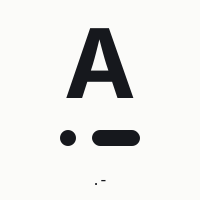
.-
- Said aloud
- di-dah
- Elements
- 2
Short then long, and the first character where direction starts to matter.
A is a dot followed by a dash, and N is a dash followed by a dot. Same two elements, opposite order, two different letters. This is the first thing a learner meets that cannot be handled by counting, because the count is identical and only the shape differs.
That pairing is why A and N are a bad place to start and a very good place to arrive. Any teaching method that introduces them together is asking you to distinguish a rhythm from its mirror image before you can reliably hear rhythms at all. The Koch method deliberately begins with K and M instead, two characters that sound nothing like each other, and only introduces mirror pairs once the underlying skill is there.
Said aloud, the difference is obvious in a way it never is on paper. Nobody confuses "di-dah" with "dah-dit" when they are speaking. The whole trick of learning Morse by ear is getting the sound in your head to behave the way your voice already does.
A is also the letter that shows what the timing standard is actually for. The dash is three dots long, and the gap between the dot and the dash inside the letter is one dot. Send the dash too short and A collapses towards I, two dots; hold the gap too long and it splits into E followed by T. The letter only exists as A while the ratios hold, and a translator that approximates them produces something that reads correctly on the page and wrong in the ear.
On the air, A does double duty. Sent on its own it is just a letter, but run into the next character with no gap it becomes half of a prosign: AS for "wait", AR for "end of message". References write these with a bar over the letters to say they are one symbol. An operator who leaves the normal gap sends A, S; one who closes it sends a single instruction. Same elements, different meaning, and the only thing that changed was silence.
Practise it in: AN NA
How long it takes
At a given speed every character has a fixed length. A takes this long to send, gaps inside it included.
| 5 WPM | 1.20 s |
|---|---|
| 10 WPM | 0.60 s |
| 20 WPM | 0.30 s |
What it gets confused with
- A with its last element clipped is E:
.(E) - A with one element too many is R:
.-.(R) - A with one element too many is W:
.--(W) - A heard backwards is N:
-.(N)
Frequently asked
What is A in Morse code?
A is dot-dash, said aloud as di-dah: one short signal followed by one long one, with the long one three times the length of the short. It is one of the four two-element letters, and the first most people learn where the order of the elements, and not just their count, decides the letter.
How do I tell A from N?
By ear, and only by ear. A is di-dah, N is dah-dit: the same two elements the other way round. Written down they are a puzzle; spoken, nobody confuses them. If you are getting them wrong, you are reading the shapes rather than hearing them, and the fix is to slow the gaps, not the letters.
Why is A so short?
Because it is common. The codes were assigned by frequency in English, and A is the third most frequent letter, so it got two elements. Q and Z, which barely appear, got four. The alphabet looks irregular because it is optimised, and A is one of the beneficiaries.
Where does A appear in prosigns?
In AS, meaning wait, sent as one run: di-dah-di-di-dit. And in AR, end of message, di-dah-di-dah-dit. In both the A is not a letter but the first half of a single symbol, and the gap that would separate A from the next letter is deliberately absent.
B in Morse Code
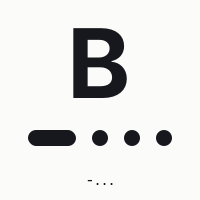
-...
- Said aloud
- dah-di-di-dit
- Elements
- 4
Dash then three dots, and V read backwards.
B is dah-di-di-dit. Reversed it becomes V, di-di-di-dah, which makes the two a mirror pair separated by nothing but direction. Written down they are easy to tell apart; heard at speed by someone who is still reading and not yet listening, they are the classic swap.
B also sits one element above D and one below the digit 6, which puts it in a run where a single missed or hallucinated dot changes the answer. That density is normal for four-element characters and is the reason the alphabet rewards learning by shape: there is no local landmark to check yourself against.
Drill it against V, never alone. A mirror pair practised together stops being two characters and becomes one distinction, which is both faster to learn and harder to lose.
On the air B is quiet as a letter and busy as an abbreviation. BK, sent as two letters, means break: the sending operator is pausing to let the other station reply mid-exchange, the closest thing Morse has to a conversational interruption. B4 is before, and in the cut-number system that contest operators use to save time, B stands in for 7, because the two codes share a shape: 7 is dah-dah-di-di-dit, B is the same run without the second dash. An operator who hears 5BB in a signal report has been sent 577.
B sits at the quiet end of English letter frequency, around twentieth, and its four-element code reflects that: the frequency-based assignment gave the common letters the short codes and let B be long. It appears often enough in ordinary text to need a firm memory, and its mirror V appears more often still, so the pair repays the drill.
Practise it in: BV VB B6
How long it takes
At a given speed every character has a fixed length. B takes this long to send, gaps inside it included.
| 5 WPM | 2.16 s |
|---|---|
| 10 WPM | 1.08 s |
| 20 WPM | 0.54 s |
What it gets confused with
- B with its last element clipped is D:
-..(D) - B with one element too many is 6:
-....(6) - B heard backwards is V:
...-(V)
Frequently asked
What is B in Morse code?
B is dah-di-di-dit: one long signal and then three short ones. It is a four-element letter, and the exact reverse of V, which is three short signals and then one long. The dash is three times the length of a dot, and the gaps inside the letter are one dot each.
Why do B and V get mixed up?
Because they are the same four elements in opposite order, and a learner who is counting elements gets the same count for both. The cure is to stop counting and hear the shape: B starts heavy and trails off, V builds up to its dash. Send them alternately until the difference is a feeling and not a calculation.
C in Morse Code
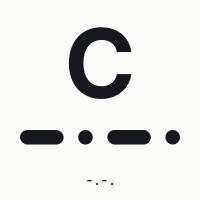
-.-.
- Said aloud
- dah-di-dah-dit
- Elements
- 4
Alternating long and short, and half of the most-sent call in amateur radio.
C is dah-di-dah-dit, a strict alternation that gives it an unusually regular sound for a four-element character. Nothing else in the alphabet alternates cleanly across four elements, which makes C one of the easier long codes to hold onto.
It is also the first letter of CQ, the general call, "I am looking for anyone who can hear me". An operator sending CQ is not addressing a station; they are opening a conversation with whoever is listening, and the phrase is the most-sent thing on the amateur bands by a wide margin. Learning C and Q early pays for itself immediately.
C clips to K, which is worth knowing because K is itself a common prosign. Losing the final dot of a C turns a letter into an instruction to reply.
C is also a word of its own on the air. Sent alone in answer to a question it means yes, or confirmed, the way R means received; CFM is the longer form. CL means the station is closing down, CUL is see you later, and CU is see you. The operator who ends a contact with TNX ES CUL 73 has thanked you, said and, promised to see you later and wished you well, in nine characters.
The alternating shape is worth hearing on purpose. Say it aloud and it has a swing to it that the letters around it lack: K is the same swing one element shorter, and Y is the same start with a different end. C is common enough in English, about twelfth by frequency, that it got a four-element code with a rhythm that is hard to lose, and that trade is the whole logic of the assignment: length where it can be afforded, memorability where it cannot.
Practise it in: CQ CQ CQ
How long it takes
At a given speed every character has a fixed length. C takes this long to send, gaps inside it included.
| 5 WPM | 2.64 s |
|---|---|
| 10 WPM | 1.32 s |
| 20 WPM | 0.66 s |
What it gets confused with
- C with its last element clipped is K:
-.-(K)
Frequently asked
What is C in Morse code?
C is dah-di-dah-dit: long, short, long, short. Four elements that strictly alternate, which no other letter does across four. It is the first letter of CQ, the general call that means anyone who can hear me, please answer.
What does CQ mean?
CQ is the general call. An operator sending CQ CQ CQ DE followed by their callsign is not addressing anyone in particular; they are inviting whoever hears them to reply. The convention is older than radio and comes from wired telegraphy, where it read as sécurité in French, a call for attention.
D in Morse Code
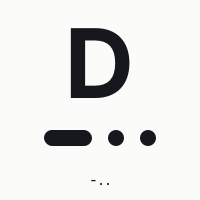
-..
- Said aloud
- dah-di-dit
- Elements
- 3
Dash-dot-dot, U heard backwards, and a reminder that order carries meaning.
D is dash-dot-dot. Reverse it and you have U, dot-dot-dash. They use the same three elements in the same proportions, and only the order tells them apart: the same relationship A and N have, one element further along.
Mirror pairs like this are the strongest argument for learning by ear. Written down they are a puzzle; heard, they are two different sounds. On the page, D and U are two arrangements of the same marks and require careful reading. Spoken, "dah-di-dit" and "di-di-dah" are nothing alike, and no one who has heard them confuses them.
D clips to N and extends to B and X, which puts it in a dense neighbourhood. If you find yourself hesitating on it, drill it against U, never in isolation: the pair is the difficulty, not the character.
D carries one of the most-sent words in the whole code: DE, meaning from. Every call on the air separates the station being called from the station calling with it, so W1AW DE K2ABC reads as W1AW, from K2ABC. An operator who has never sent a full sentence in Morse has sent DE a thousand times. DX is the other one: distance, and by extension a distant station, the thing every operator with an antenna is quietly hunting.
In the cut-number system D stands for 8, because 8 is dah-dah-dah-di-dit and D is the same shape with two of the dashes removed. Contest operators sending a serial number of 588 send 5DD and save six dashes. It is worth knowing even if you never use it, because you will hear it, and an unexplained D in the middle of a number is baffling until you do.
Practise it in: DU UD DUD
How long it takes
At a given speed every character has a fixed length. D takes this long to send, gaps inside it included.
| 5 WPM | 1.68 s |
|---|---|
| 10 WPM | 0.84 s |
| 20 WPM | 0.42 s |
What it gets confused with
- D with its last element clipped is N:
-.(N) - D with one element too many is B:
-...(B) - D with one element too many is X:
-..-(X) - D heard backwards is U:
..-(U)
Frequently asked
What is D in Morse code?
D is dah-di-dit: one long signal and two short. It is a three-element letter, the mirror of U, and one dot short of B. Said aloud it has a falling shape, heavy at the start and light at the end.
What does DE mean in Morse code?
DE means from. It separates the callsign of the station being called from the callsign of the station calling: CQ CQ DE K2ABC is a general call from K2ABC. It is French in origin, like much of the code's operating vocabulary, and it is one of the first things a listener learns to recognise whole.
E in Morse Code
.
- Said aloud
- dit
- Elements
- 1
The shortest character in Morse code, and the reason the whole alphabet is fast.
E is a single dot because E is the most common letter in English. That is not a coincidence or an aesthetic choice: the codes were assigned by frequency, and the story is that Alfred Vail went to a printer and counted the type in the compositor’s case to find out which letters were used most. The letters you need constantly are the ones you can send fastest.
This is what makes Morse quicker than a fixed-length code would be. A code that gave every letter five elements, as the digits do, would be perfectly regular and about twice as slow to send in practice. The irregularity is the optimisation.
For a learner E is where the counting habit starts and has to stop. A single dot is easy to count. Two dots is easy to count. By four you are guessing, and by any real speed you are lost. E and I and S and H are the same sound repeated, and the only way to tell them apart at speed is to stop hearing dots and start hearing shapes.
E is the most frequent letter in English by a wide margin, close to an eighth of all letters in ordinary text, and the code was assigned with that in mind: the shortest possible symbol went to the letter that would be sent most. T, the second most frequent, got the single dash. Between them, E and T account for roughly a fifth of the letters in a typical English message, and every one of them takes one element to send.
On the air E does more than spell. ES means and, because the ampersand's old telegraph code has the same shape; a whole conversation in abbreviations strings its phrases together with it. E is also 5 in the cut-number system, since 5 is five dots and E is the first of them, so 5NN, the contest-speed way of sending a 599 signal report, sometimes arrives as ENN. And two dots sent as a pair, with a gap, is the informal sign-off some operators use at the very end of a contact: dit dit, the sound of a door closing.
Practise it in: EEE
How long it takes
At a given speed every character has a fixed length. E takes this long to send, gaps inside it included.
| 5 WPM | 0.24 s |
|---|---|
| 10 WPM | 0.12 s |
| 20 WPM | 0.06 s |
What it gets confused with
Frequently asked
What is E in Morse code?
E is a single dot: the shortest character in the code. It is one element long, and the only thing that distinguishes it from T, the single dash, is duration. The letter exists as a contrast with silence, so the gap after it matters as much as the dot itself.
Why is E so short?
Because it is the most common letter in English, and the code was assigned by frequency. The one-element codes went to the two letters that appear most, E and T; the four-element codes went to letters like Q, X and Z that barely appear at all. The alphabet looks arbitrary and is optimised.
F in Morse Code
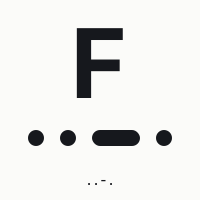
..-.
- Said aloud
- di-di-dah-dit
- Elements
- 4
Three shorts and a long, offset: the mirror of L.
F is di-di-dah-dit. Reverse it and you have L, di-dah-di-dit. The pair joins A/N, D/U, B/V, G/W and Q/Y on the list of characters that differ only in direction. Direction, then, is the thing to train.
F is dense in the other direction too: clip its last element and it becomes U. So a single element lost at the end, or the whole shape heard backwards, both land on a real letter, never on nonsense. There is no error here that announces itself.
The practical consequence is that F rewards clean sending as much as clean copying. A hurried F with a clipped tail is genuinely indistinguishable from a U, and the receiver has no way to know which you meant.
The abbreviations F carries are gentle ones. FB, fine business, is the standard compliment for a good signal or a good contact. FER is for, in the telegraphese that drops vowels wherever the meaning survives. FM is from, though DE is the form used in calls. And a station signing FB OM TNX FER QSO has said, in effect, good job old man, thanks for the contact, in a form so compressed that a newcomer needs the phrasebook and a regular needs nothing.
F is a middle-frequency letter in English and a four-element code, and the pairing with L matters more than the code itself. The two letters are heard as mirror images, and a learner who drills F and L together arrives at the alphabet's mirror pairs (A and N, D and U, B and V, G and W, Q and Y) already knowing what the difficulty feels like: the count is identical and only the order tells them apart.
Practise it in: FL LF FU
How long it takes
At a given speed every character has a fixed length. F takes this long to send, gaps inside it included.
| 5 WPM | 2.16 s |
|---|---|
| 10 WPM | 1.08 s |
| 20 WPM | 0.54 s |
What it gets confused with
Frequently asked
What is F in Morse code?
F is di-di-dah-dit: two short signals, one long, one short. Four elements, with the dash third. It is the exact reverse of L, di-dah-di-dit, and one element longer than U.
What does FB mean in Morse code?
FB is fine business, the standard compliment on the air: a good signal, a good contact, a job well done. It is one of the older abbreviations, from the days when operators were paid by the word and a two-letter compliment was the affordable kind.
G in Morse Code
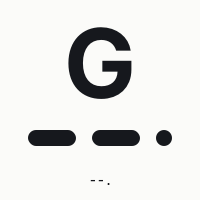
--.
- Said aloud
- dah-dah-dit
- Elements
- 3
Two longs and a short, W backwards, and one element from three other letters.
G is dah-dah-dit, the mirror of W. It also clips to M and extends to both Z and Q, which makes it one of the most crowded neighbourhoods in the alphabet: four different single-element errors, all of them landing on real letters.
That is not a reason to avoid G but a reason to learn it precisely. Characters with many near neighbours are exactly the ones where an approximate memory fails, because every mistake produces something plausible instead of something obviously wrong.
If you are drilling, take G with M, W, Z and Q together, never one at a time. The group is the difficulty; the individual character is not.
G opens the greetings. GM is good morning, GA good afternoon, GE good evening, GN good night; GB is goodbye and GL is good luck. A contact that begins GM OM and ends GL 73 GB has been polite from start to finish without a single full word. GUD is good and GG is going, and none of them are in the standard: they are operating custom, learned by listening, and the reason the same abbreviations are heard from Tokyo to Tennessee.
The crowded neighbourhood around G has a practical side. Because G, M, W, Z and Q are all one element apart, a receiving operator who is unsure of one of them can often resolve it from the word: a G that might have been Z is almost never Z in English, since Z is rare and G is not. Context does real work in Morse reception, and the letters with the most neighbours are the ones where it does the most.
Practise it in: GM GW GZ GQ
How long it takes
At a given speed every character has a fixed length. G takes this long to send, gaps inside it included.
| 5 WPM | 2.16 s |
|---|---|
| 10 WPM | 1.08 s |
| 20 WPM | 0.54 s |
What it gets confused with
- G with its last element clipped is M:
--(M) - G with one element too many is Z:
--..(Z) - G with one element too many is Q:
--.-(Q) - G heard backwards is W:
.--(W)
Frequently asked
What is G in Morse code?
G is dah-dah-dit: two long signals and one short. It is a three-element letter, the reverse of W, and one dot short of Z and one dash short of Q. Said aloud it lands heavily and finishes light.
What do GM, GA and GE mean?
Good morning, good afternoon and good evening. Operators open a contact with the one that fits their own local time, which can be different from the other station's; a GM sent to someone eating dinner is normal and nobody minds.
H in Morse Code
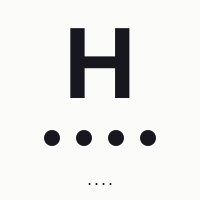
....
- Said aloud
- di-di-di-dit
- Elements
- 4
Four dots, past the point where anyone can count them.
H is four dots. At 20 words per minute those four dots and the gaps between them take under half a second in total, which is comfortably faster than anyone can count. If you are still counting when you reach H, this is the character that tells you.
H is also where the confusion set gets crowded. Clipped it is S, extended it is the digit 5, and neither mistake is exotic: a moment of noise or inattention produces both routinely. Operators working weak signals learn to read H by its weight, never by counting its parts: it is the longest of the all-dot characters that is still a letter, and it sounds hurried in a way S does not.
A useful drill is to send S and H alternately at a speed you find slightly uncomfortable. Counting collapses immediately, and what is left is the difference in shape, the only thing worth learning.
H is where the counting habit finally breaks. A learner who has managed E, I and S by counting dots reaches H, four of them, and finds that at any real speed four fast dots cannot be counted at all: they arrive as a burst, and the burst has to be recognised as a shape. This is the letter that persuades most people to learn by ear, and it is the reason teachers introduce it early, so the lesson lands before the habit sets.
On the air H is best known as half of HI, the Morse laugh: di-di-di-dit di-dit, said aloud, has a chuckle in it, and operators have used it as laughter for over a century. HW? is how copy, asking how well the other station is receiving. HR is here. And eight dots in a row, which is no letter, is the error signal: the sender made a mistake, and what follows is the correction.
Practise it in: HS SH H5
How long it takes
At a given speed every character has a fixed length. H takes this long to send, gaps inside it included.
| 5 WPM | 1.68 s |
|---|---|
| 10 WPM | 0.84 s |
| 20 WPM | 0.42 s |
What it gets confused with
- H with its last element clipped is S:
...(S) - H with one element too many is 5:
.....(5) - H with one element too many is 4:
....-(4)
Frequently asked
What is H in Morse code?
H is four dots: di-di-di-dit. It is the longest run of dots among the letters, and the last step of the chain that runs E, I, S, H, each one dot longer than the last. The digit 5 is the same run with a fifth dot.
What does HI mean in Morse code?
HI is laughter. Sent as two letters it sounds like a chuckle, di-di-di-dit di-dit, and operators have used it that way since the telegraph. HI HI is a bigger laugh.
I in Morse Code

..
- Said aloud
- di-dit
- Elements
- 2
Two dots: the second link in the chain that catches every beginner.
I is two dots, sitting between E (one) and S (three) in a run of five characters that are the same sound repeated: E, I, S, H, and the digit 5. Nothing distinguishes them except how many you counted, which makes them the single hardest group in the alphabet to learn and the reason counting has to be abandoned early.
Two is the last count a person can do reliably at speed. Three is borderline. Four is a guess dressed up as a decision, and by five you are simply hoping. This is not a matter of practice, it is a limit on how fast anyone can count discrete events, and it caps a counting learner at roughly eight words per minute no matter how much they drill.
The way out is to hear "di-dit" as one thing, the way you hear a word and not its letters. Farnsworth spacing exists precisely to force this: the character arrives too fast to count while the gap after it stays long enough to write it down.
I is the fifth or sixth most frequent letter in English and one of the four two-element codes, which is exactly where the frequency assignment would put it. Its trouble is not its own shape, which is as plain as a shape can be, but its position in the dot chain: one dot short of S and one long of E, so that a missed dot or an imagined one moves the reader a whole letter along the chain without any warning that anything went wrong.
The practical lesson from I is about gaps. Two dots with the standard one-dot gap between them are I; two dots with a three-dot gap between them are E E, two separate letters. At slow speeds the difference is obvious, and at speed it is the single most common way a beginner's sending goes wrong: the dots are right, the silence between them is not, and the receiver hears letters the sender never meant.
Practise it in: EI IS SH
How long it takes
At a given speed every character has a fixed length. I takes this long to send, gaps inside it included.
| 5 WPM | 0.72 s |
|---|---|
| 10 WPM | 0.36 s |
| 20 WPM | 0.18 s |
What it gets confused with
- I with its last element clipped is E:
.(E) - I with one element too many is S:
...(S) - I with one element too many is U:
..-(U)
Frequently asked
What is I in Morse code?
I is two dots: di-dit. It is a two-element letter, one dot longer than E and one dot shorter than S, and one of the four letters made of two elements along with A, N and M.
How is I different from E E?
By the gap. Inside a letter the dots are one dot-length apart; between letters the gap is three. Two dots close together are I; two dots with a longer silence between them are two separate Es. Timing the silence is as much a part of sending as timing the tones.
J in Morse Code
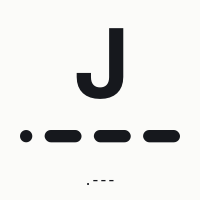
.---
- Said aloud
- di-dah-dah-dah
- Elements
- 4
One short and three longs: a rare letter, and priced accordingly.
J is di-dah-dah-dah, thirteen units long counting the gaps inside it, which makes it one of the most expensive characters in the alphabet to send. That is deliberate. Codes were assigned by how often letters appear in English, so J, which barely appears, was given a code nobody would mind being slow.
This is the frequency logic that gives E a single dot, seen from the other end. The alphabet is not irregular by accident; it is irregular because regularity would cost time on exactly the letters you send most.
J clips to W and extends to the digit 1, which is di-dah-dah-dah-dah. The digits are all five elements, so several of them sit one element above a letter in precisely this way.
J is one of the few letters whose shape is genuinely its own. One short and three long is a sound nothing else in the alphabet makes, and the long tail gives it a swagger when said aloud: di-dah-dah-dah. Learners rarely confuse it with anything; what they do is under-send the dashes, so that the third one arrives short and the letter collapses toward W, di-dah-dah. Hold the three dashes to their full length and J looks after itself.
It is rare in English, under a quarter of one percent of letters, and rarer still in operating abbreviations, where it hardly appears. Its home is in callsigns: JA prefixes belong to Japan, and an operator in Europe or the Americas who hears a J at the start of a call knows at once where it comes from. That is where most J’s on the air are sent, and it is why every operator can copy the letter cleanly despite hardly ever needing it in a word.
Practise it in: J1 1J JW
How long it takes
At a given speed every character has a fixed length. J takes this long to send, gaps inside it included.
| 5 WPM | 3.12 s |
|---|---|
| 10 WPM | 1.56 s |
| 20 WPM | 0.78 s |
What it gets confused with
Frequently asked
What is J in Morse code?
J is di-dah-dah-dah: one short signal and then three long ones. Four elements, and among the slowest letters to send at thirteen units including the gaps inside it. It is W with a third dash on the end.
Why is J so long?
Because it is rare. The code was assigned by how often letters appear in English, and J appears about once in every five hundred letters, so it was given a code nobody would mind being slow. The saving went to E, T, A and the other common letters.
K in Morse Code

-.-
- Said aloud
- dah-di-dah
- Elements
- 3
Dash-dot-dash: the other half of the Koch pair, and an invitation to transmit.
K is dash-dot-dash, a symmetrical shape that reads the same backwards. Together with M it forms the pair the Koch method opens with, chosen because the two are impossible to confuse: one is two long tones, the other is long-short-long.
K also carries a meaning of its own on the air. Sent at the end of a transmission it means "over, anyone may reply", so an operator calling CQ ends with it. The related prosign KN, sent as one run, narrows that to "over, but only the station I am talking to". These are not letters in those positions; they are punctuation for a conversation.
Its symmetry makes K one of the easier characters to hold onto under noise. A shape that reads the same in both directions cannot be got backwards, which removes an entire class of error before it starts.
K is the letter a Koch-method learner meets first, and for a reason that has nothing to do with the alphabet’s order. The Koch method starts with K and M because they sound nothing alike, dah-di-dah against dah-dah, and a beginner can tell them apart from the first minute. Everything that follows builds on that: a learner who has heard two shapes as shapes, not as counts, has the habit the whole method depends on before the harder pairs arrive.
It is also an instruction. K sent at the end of a transmission means go ahead, over, anyone may reply; an operator calling CQ ends with it. KN, sent as a single run with no gap, narrows the invitation to the station already in contact: go ahead, only you. And OK is OK, sent as two letters, the same everywhere. The K callsign prefix belongs to the United States, so K and W between them begin a very large share of the calls on the air.
Practise it in: CQ CQ K
How long it takes
At a given speed every character has a fixed length. K takes this long to send, gaps inside it included.
| 5 WPM | 2.16 s |
|---|---|
| 10 WPM | 1.08 s |
| 20 WPM | 0.54 s |
What it gets confused with
- K with its last element clipped is N:
-.(N) - K with one element too many is C:
-.-.(C) - K with one element too many is Y:
-.--(Y)
Frequently asked
What is K in Morse code?
K is dah-di-dah: long, short, long. Three elements, symmetrical, with the same shape read forwards or backwards. It is the first letter a Koch-method learner meets, because it sounds like nothing else a beginner has heard yet.
What does K mean at the end of a message?
Go ahead. It hands the channel to the other station: I have finished, your turn. KN, sent as one symbol, means go ahead but only the station I am already talking to; SK means the contact is over.
L in Morse Code
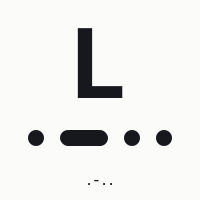
.-..
- Said aloud
- di-dah-di-dit
- Elements
- 4
Short, long, short, short: the mirror of F.
L is di-dah-di-dit, F reversed. Like every mirror pair it is trivial to distinguish written down and easy to swap by ear until the rhythms are separate shapes and no longer sequences of elements.
L clips to R, which is itself a common prosign meaning "received". As with C and K, an element lost at the end of L does not produce nonsense, it produces something an operator will read as a completely ordinary acknowledgement.
Say it aloud a few times. "Di-dah-di-dit" against F’s "di-di-dah-dit" is an obvious difference in speech and an easy confusion on paper. That gap is the whole argument for learning this code by ear.
L is a common letter, eleventh or so in English, and it got a four-element code anyway, because the three-element codes had already gone to letters more common still. It is one of the reasons Morse is slower in practice than the frequency assignment suggests: a word like HELLO spends most of its length on the two Ls, nine units each including the gaps inside them, against one for the E.
Its mirror F is the pair to drill, and the operating vocabulary adds a reason to know L well: LID is the old name for a poor operator, a word said with affection or not, and an operator who copies it as F-something has missed the joke. L also turns up in CUL, see you later, one of the commonest sign-offs, where it is the last letter heard before the 73.
Practise it in: LF FL LR
How long it takes
At a given speed every character has a fixed length. L takes this long to send, gaps inside it included.
| 5 WPM | 2.16 s |
|---|---|
| 10 WPM | 1.08 s |
| 20 WPM | 0.54 s |
What it gets confused with
Frequently asked
What is L in Morse code?
L is di-dah-di-dit: short, long, short, short. Four elements with the dash second. It is the exact reverse of F, and one element longer than R, which is di-dah-dit.
How do I tell L from F?
By where the dash falls. In L the dash is second; in F it is third. Said aloud, L rises early and settles, F builds and drops. Send them alternately, LF FL, until the difference is a feeling.
M in Morse Code

--
- Said aloud
- dah-dah
- Elements
- 2
Two dashes, and, with K, where the Koch method starts.
M is two dashes. The Koch method famously begins with just two characters, K and M, sent at full target speed from the first minute, and only adds a third once those two can be copied reliably. The choice is not arbitrary: K and M share no structure at all, so telling them apart requires no counting and no comparison of similar shapes.
That is the whole insight behind the method. Traditional teaching starts at A and works alphabetically at a slow speed, which means a learner meets A and B and C: a mirror pair and two long codes, while also learning to count. Koch starts with a pair that cannot be confused, at a speed where counting is impossible, so the correct habit is the only one available.
M has its own trap on the dash side: T is one dash, M is two, O is three. It is the same counting problem as E-I-S-H, transposed. The same fix applies.
M is the second letter a Koch learner meets, paired with K because two dashes and dah-di-dah sound unrelated. It is also the middle of the dash chain: T is one dash, M two, O three, the same trap as E, I, S with dashes instead of dots, and the same fix. At any real speed nobody counts two dashes; the letter is heard as a shape with a certain weight, and O is the same shape with more of it.
On the air M is quiet as an abbreviation. MSG is message, MNI is many, and MA is milliamperes in the technical talk about rigs. It is more often heard inside words. M is a middle-frequency letter in English, around fourteenth, and its two-element code is one of the places where the assignment departs from frequency alone.
Practise it in: KM MK MM
How long it takes
At a given speed every character has a fixed length. M takes this long to send, gaps inside it included.
| 5 WPM | 1.68 s |
|---|---|
| 10 WPM | 0.84 s |
| 20 WPM | 0.42 s |
What it gets confused with
- M with its last element clipped is T:
-(T) - M with one element too many is G:
--.(G) - M with one element too many is O:
---(O)
Frequently asked
What is M in Morse code?
M is two dashes: dah-dah. A two-element letter, one dash longer than T and one shorter than O. It is one of the first two letters most people learn, paired with K.
Why do learners start with K and M?
Because they sound unlike each other. The Koch method picks the first two characters to be as different as possible, so that a beginner distinguishes them by ear from the start and never learns to count elements. Similar-sounding pairs come later, once the skill of hearing shapes exists.
N in Morse Code
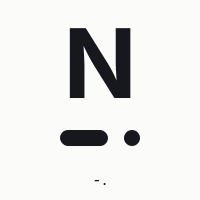
-.
- Said aloud
- dah-dit
- Elements
- 2
Long then short, A backwards, and one of the two characters Koch training starts near.
N is a dash then a dot: exactly A reversed. The two are the canonical example of a mirror pair, and between them they demonstrate why Morse is a rhythmic code and not a counted one. Two elements, same lengths, different order, different letter.
N is also extremely common in English, and that earned it a two-element code under the same frequency logic that gave E a single dot. The short codes are not the easy letters, they are the frequent ones, and the two lists happen to overlap.
If you are drilling mirror pairs, do it with the sound and not the page. A and N look almost identical written down and sound completely different spoken: "di-dah" against "dah-dit". Reading them is the slow way to learn them.
N is a word of its own on the air: sent alone in answer to a question it means no, the opposite of C. NR is number, NW is now, NIL is nothing, as in nothing received. The N callsign prefix belongs to the United States alongside K and W, so a very large number of calls begin with it. And in the cut-number system N stands for 9, because 9 is dah-dah-dah-dah-dit and N is the same shape with three of the dashes taken away: a contest station sending a 599 report sends 5NN, and it is heard far more often than the full digits.
N is the sixth most frequent letter in English and was given a two-element code accordingly. The frequency logic put A and N, two of the commonest letters, into the same pair of elements in opposite orders, which is efficient for sending and awkward for learning; the cost was accepted because the common letters are the ones where a short code pays off most.
Practise it in: NA AN
How long it takes
At a given speed every character has a fixed length. N takes this long to send, gaps inside it included.
| 5 WPM | 1.20 s |
|---|---|
| 10 WPM | 0.60 s |
| 20 WPM | 0.30 s |
What it gets confused with
- N with its last element clipped is T:
-(T) - N with one element too many is D:
-..(D) - N with one element too many is K:
-.-(K) - N heard backwards is A:
.-(A)
Frequently asked
What is N in Morse code?
N is dah-dit: one long signal and one short. It is the exact reverse of A, di-dah, and one dash short of D. Said aloud it falls; A rises.
What does 5NN mean?
It is 599, the best possible signal report, sent with cut numbers: N stands in for 9 because the two codes share a shape and N is four dashes shorter. Contest operators send it thousands of times a weekend, and almost nobody sends the full digits.
O in Morse Code
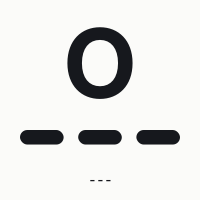
---
- Said aloud
- dah-dah-dah
- Elements
- 3
Three dashes: the long half of SOS, and impossible to mistake for anything.
O is three dashes. It takes eleven units to send where E takes one, which makes it one of the slowest letters in the alphabet, and that is fine: O is common enough to matter but not so common that its length hurts.
What O has going for it is unmistakability. Three long tones in a row is a sound nothing else in the alphabet produces, which is part of why the SOS signal works so well: the three-short, three-long, three-short pattern has a heavy middle that survives noise, distance, and a badly made signal lamp.
The mirror of the E-I-S-H chain applies here too, with dashes instead of dots: T is one dash, M is two, O is three. Same trap, same fix. Hear the shape, do not count the tones.
O is a word too. OM is old man, the universal form of address between operators regardless of age; OK is OK; OP is operator, as in OP HR IS JOHN, the operator here is John. And the O in SOS is where the signal gets its weight: three long tones in the middle of a burst of shorts is a pattern that survives noise, and it is the part of the distress call a listener hears first through static.
O is the fourth most frequent letter in English, and a three-dash code is a long one for a letter that common: eleven units, more than any other three-element letter. The two- and one-element codes were already spent on E, T, A, I, N and M, and what O got instead is a shape nothing else in the alphabet produces.
Practise it in: SOS
How long it takes
At a given speed every character has a fixed length. O takes this long to send, gaps inside it included.
| 5 WPM | 2.64 s |
|---|---|
| 10 WPM | 1.32 s |
| 20 WPM | 0.66 s |
What it gets confused with
- O with its last element clipped is M:
--(M)
Frequently asked
What is O in Morse code?
O is three dashes: dah-dah-dah. Three elements and eleven units long including the gaps inside it, the slowest of the three-element letters. It is the middle of SOS.
What does OM mean in Morse code?
Old man: the standard way one operator addresses another, whatever their age. GM OM is good morning old man, and it is as friendly as the code gets. YL, young lady, is the counterpart.
P in Morse Code
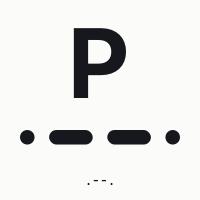
.--.
- Said aloud
- di-dah-dah-dit
- Elements
- 4
Short, long, long, short, symmetrical, so it cannot be got backwards.
P is di-dah-dah-dit, and it reads the same in both directions. That symmetry removes an entire class of error before it starts: there is no mirror letter to confuse it with, because reversing it produces P again.
Only a handful of characters have this property, P, X, R, K, and the all-dot and all-dash runs. They are disproportionately easy to hold onto under noise, and they are useful anchors when you are learning: a symmetrical character heard badly is still the same character.
P clips to W. That is its one real neighbour, and it is worth drilling the pair together for the same reason mirror pairs are drilled together.
P reads the same in both directions, di-dah-dah-dit, which makes it one of the alphabet’s palindromes along with K, R and X, and it is the reason reversal is not among its confusions: heard backwards it is still P. Its risks are at the ends, where a clipped final dot makes W and an added dash makes the accented À, which no English word contains.
Its abbreviations are polite ones. PSE is please, as in PSE QSL, please confirm; PWR is power; PSE K is please go ahead. P is a low-frequency letter in English, around twentieth, and its four-element code has a rocking rhythm when said aloud that most learners find easy to keep hold of once they have heard it a few times.
Practise it in: PW WP P
How long it takes
At a given speed every character has a fixed length. P takes this long to send, gaps inside it included.
| 5 WPM | 2.64 s |
|---|---|
| 10 WPM | 1.32 s |
| 20 WPM | 0.66 s |
What it gets confused with
- P with its last element clipped is W:
.--(W)
Frequently asked
What is P in Morse code?
P is di-dah-dah-dit: short, long, long, short. Four elements, symmetrical, the same shape read forwards or backwards. It is W with a dot on the end.
What does PSE mean?
Please. PSE QSL is please confirm the contact, PSE K is please go ahead. The vowels are dropped, as they are in most of the operating abbreviations, because a word that is still readable without them is a word that can be sent faster.
Q in Morse Code
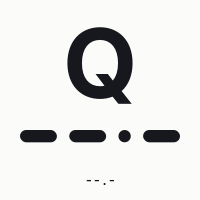
--.-
- Said aloud
- dah-dah-di-dah
- Elements
- 4
Long, long, short, long, and the letter behind an entire vocabulary.
Q is dah-dah-di-dah, the mirror of Y. It is also the first letter of the Q-code, a system of three-letter abbreviations that lets operators who share no language hold a working conversation: QTH is "my location is", QSL is "I acknowledge receipt", QRM is "I am being interfered with".
The Q-codes exist because Morse makes every character cost time, and a code that turns a whole sentence into three characters is worth learning. They predate radio amateurs by decades and are still in daily use, which is unusual for anything invented for a telegraph.
Q clips to G, one of its several dense neighbours. Drill it with G, Y and M, never alone.
Q is the letter of the Q-code, the set of three-letter groups that carry most of the technical conversation on the air. QTH is location, QSL is confirmation, QRZ is who is calling me, QRM is interference from other stations and QRN is static, QSB is fading, QRP is low power, QSO is a contact, QSY is a change of frequency, QRT is I am stopping. Each can be a question or a statement depending on the query sign that follows it, and each replaces a sentence.
Q itself barely appears in English text, under one letter in a thousand, so its long code costs almost nothing in ordinary words and a great deal on the air, where it opens every Q-signal. Operators accept the trade: the code is old, the Q-signals are older than amateur radio, and nobody is going to reassign them. Learn Q by its mirror Y and by the swing of its rhythm, dah-dah-di-dah, which rises at the end where Y falls.
Practise it in: QSL QTH QRM
How long it takes
At a given speed every character has a fixed length. Q takes this long to send, gaps inside it included.
| 5 WPM | 3.12 s |
|---|---|
| 10 WPM | 1.56 s |
| 20 WPM | 0.78 s |
What it gets confused with
Frequently asked
What is Q in Morse code?
Q is dah-dah-di-dah: long, long, short, long. Four elements, with the dot third. It is the exact reverse of Y, and G with a dash added to the end.
What are Q-codes?
Three-letter groups beginning with Q that stand for whole questions and answers: QTH for where are you, QSL for do you confirm, QRZ for who is calling me. They date from the earliest days of radio, when operators of different languages needed a shared vocabulary, and they are still the working language of Morse on the air.
R in Morse Code

.-.
- Said aloud
- di-dah-dit
- Elements
- 3
Dot-dash-dot, and, on the air, the word "received".
R is dot-dash-dot, the mirror image of K and symmetrical in the same way. The two make a useful pair to drill together precisely because they are structurally identical and rhythmically opposite: di-dah-dit against dah-di-dah.
Sent on its own, R means "received, understood", an entire acknowledgement compressed into three elements. It is the most economical thing in the language and a good illustration of why abbreviation matters in a code where every character costs real time. An operator who writes "roger" instead has spent five characters to say what one said.
R extends to L (dot-dash-dot-dot) with one more element, and clips to A with one fewer. Both are common letters, which makes R a character worth being precise about, because approximately right is wrong here.
R is the acknowledgement. Sent alone it means received, all of it, the origin of the spoken roger; an operator who has copied a message answers R and the sender moves on. RST is the signal report, readability, strength and tone, three digits that every contact exchanges. RIG is the equipment, RX and TX are receiver and transmitter, and RPT is repeat, the request a listener makes when the R was not honestly earned.
R is a palindrome, di-dah-dit, which is why heard backwards it is still R. Its neighbours are A, one dot shorter, and L, one dot longer, and both are common letters, so a clipped or extended R lands on a real word more often than on nonsense. That is a reason to send it cleanly: the receiver cannot tell an R with a lost dot from an A.
Practise it in: R R DE R
How long it takes
At a given speed every character has a fixed length. R takes this long to send, gaps inside it included.
| 5 WPM | 1.68 s |
|---|---|
| 10 WPM | 0.84 s |
| 20 WPM | 0.42 s |
What it gets confused with
Frequently asked
What is R in Morse code?
R is di-dah-dit: short, long, short. Three elements, symmetrical, the same read in either direction. It is A with a dot on the end and L with a dot taken off.
What does R mean on its own?
Received. It acknowledges that the whole of the last transmission was copied; roger in speech is the same word. It is not yes, which is C, and it is not go ahead, which is K.
S in Morse Code
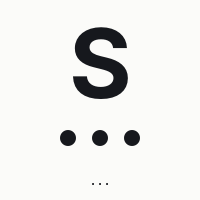
...
- Said aloud
- di-di-dit
- Elements
- 3
Three dots, one third of the most recognised signal in the world.
S is three dots, and with O it makes up the distress signal that almost everyone can recognise even with no other knowledge of Morse whatsoever. That familiarity is worth using: if you already know the rhythm of SOS, you already know S and O, and that is two characters learned before you started.
S sits in the middle of the chain that catches every beginner. E is one dot, I is two, S is three, H is four, and 5 is five: the same sound repeated, distinguished only by how many you counted. At slow speeds you can count them. At any useful speed you cannot, and the whole skill is replacing the count with a shape you recognise whole.
The practical advice is to never let yourself count past two. If you are counting, you are already at your ceiling, around eight words per minute, and it does not move. Turning on Farnsworth spacing in the translator is the standard fix: the letters stay fast, so you are forced to hear the shape, and only the gaps stretch to give you time to write it down.
S is also where the prosign convention is easiest to see. SK, end of work, is S and K run together with no gap: di-di-di-dah-di-dah. SN, understood, is S and N the same way. In each the S is not a letter you send and then pause after; it is the first three elements of a longer single symbol, and the silence that would normally follow it is the thing that has been removed. Learners who send prosigns with letter gaps send two letters, and the other station reads two letters.
There is a small historical irony in S being the letter that opens the distress signal. It was not chosen for meaning. The German radio regulations of 1905 picked the nine-element pattern because it was easy to send and impossible to mistake, and S and O happen to be the letters whose codes fit it. The mnemonics came later. If the pattern had been three dashes, three dots, three dashes, the world would know it as OSO and nobody would have found a phrase for it.
Practise it in: SOS
How long it takes
At a given speed every character has a fixed length. S takes this long to send, gaps inside it included.
| 5 WPM | 1.20 s |
|---|---|
| 10 WPM | 0.60 s |
| 20 WPM | 0.30 s |
What it gets confused with
- S with its last element clipped is I:
..(I) - S with one element too many is H:
....(H) - S with one element too many is V:
...-(V)
Frequently asked
What is S in Morse code?
S is three dots, said aloud as di-di-dit. It is the shortest three-element letter, one of the run of all-dot characters from E through I and S to H, and one third of the distress signal SOS.
Is S the same as three Es?
No, and the difference is the whole grammar of the code. Three Es are three dots separated by letter gaps of three units each. S is three dots separated by element gaps of one unit each. The dots are identical; the silence between them decides whether you sent one letter or three. That is why SOS is sent as a single unbroken rhythm: the letter gaps are removed on purpose.
Why is SOS not written S O S?
Because it is not three letters. The signal is nine elements sent as one symbol, with no gaps between the S, the O and the S; references print it with a bar across the top to say so. It was chosen in 1906 for that unbroken rhythm, and the letters were attached to it afterwards so people could remember it.
What is S most often confused with?
H, which is one dot longer, and I, which is one dot shorter. At speed these three are the same sound repeated, distinguished only by a count nobody can do reliably past two. The fix is Farnsworth spacing: send S fast enough that it is a shape, and stretch only the gaps.
T in Morse Code
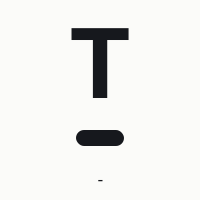
-
- Said aloud
- dah
- Elements
- 1
One dash: the other half of the two shortest codes in the alphabet.
T is a single dash, making it and E the two one-element characters. Between them they cover the two most common letters in English: the frequency-based assignment doing what it was designed to do.
T and E together are also the cleanest possible demonstration of what Morse actually encodes. They are not two different sounds; they are the same tone held for different lengths. Everything else in the alphabet is built from that one distinction repeated, so getting the ratio right (a dash is three dots long) matters more than getting the speed right.
Teaching methods often start here for a different reason: T and E cannot be confused with each other. One is short, one is long, and there is no middle case. Compare that with I and S, which differ only in how many identical sounds you counted.
T is the second most frequent letter in English, close to a tenth of all letters, and the single dash is its reward. On the air it is everywhere: TU is thank you, TNX and TKS are thanks, TMW is tomorrow, TX is transmitter. And in the cut-number system T stands for 0, since 0 is five dashes and T is the first of them; a contest station sending a serial number of 100 sends 1TT, and the two Ts are heard as zeros by anyone who has been on the air for a week.
T is also where the timing standard is most exposed. A dash is defined as three dots long, and a T sent short is nothing else in the alphabet: it is an E, heard by a receiver who has no way to know the sender meant a dash. Every other letter has internal contrast to help; T has only its length against silence. A sender whose dashes drift short loses their Ts first.
Practise it in: TEE
How long it takes
At a given speed every character has a fixed length. T takes this long to send, gaps inside it included.
| 5 WPM | 0.72 s |
|---|---|
| 10 WPM | 0.36 s |
| 20 WPM | 0.18 s |
What it gets confused with
Frequently asked
What is T in Morse code?
T is a single dash: dah. One element, three units long, the second shortest character in the code after E. Its only distinction from E is duration, so the dash must be held to its full length.
Why do contest operators send T for zero?
Because 0 is five dashes and T is one, and the receiver can tell from context that a T inside a number is a zero. Cut numbers save time on the exchanges that are sent thousands of times a weekend; 5NN for 599 and 1TT for 100 are the common ones.
U in Morse Code

..-
- Said aloud
- di-di-dah
- Elements
- 3
Dot-dot-dash, D backwards, and the shape underneath the letter V.
U is dot-dot-dash. It is D reversed, which makes the two a mirror pair, and it is V (dot-dot-dot-dash) with one dot fewer, which makes those two a clipping pair. Between them those are the two error types that account for most of what a learner gets wrong.
That density is worth using, not avoiding. A character surrounded by near-misses is a character you learn properly or not at all, and drilling U against D and V together teaches all three faster than drilling any of them alone.
The rhythm is the thing to hold: di-di-dah rises and lands, where D falls and trails. Once the two are shapes and no longer sequences, the pairing stops being a difficulty and becomes a way of checking yourself.
U is the mirror of D, and the pair is one of the alphabet’s standard drills. It is also a hinge in the dot chain: I with a dash on the end, and F or V with the tail lengthened by one element. That density means a U heard at speed can come from three or four honest mistakes, and the cure is the usual one, drilling it against every neighbour instead of on its own.
UR is your, or you are, in the abbreviated conversation of the air: UR RST 599 is your signal report is 599. In cut numbers U is 2, because 2 is di-di-dah-dah-dah and U is the same shape with two dashes fewer; it is less common than T for 0 or N for 9, but a contest operator will hear it. U is a middle-frequency letter in English, around thirteenth, and its three-element code fits that.
Practise it in: UD DU UV
How long it takes
At a given speed every character has a fixed length. U takes this long to send, gaps inside it included.
| 5 WPM | 1.68 s |
|---|---|
| 10 WPM | 0.84 s |
| 20 WPM | 0.42 s |
What it gets confused with
- U with its last element clipped is I:
..(I) - U with one element too many is F:
..-.(F) - U heard backwards is D:
-..(D)
Frequently asked
What is U in Morse code?
U is di-di-dah: two short signals and one long. Three elements, the reverse of D, and I with a dash on the end. F and V both begin with it.
What does UR mean in Morse code?
Your, or you are. UR RST 599 is your report is 599; UR SIG is your signal. It is one of the small set of abbreviations every operator uses in every contact.
V in Morse Code
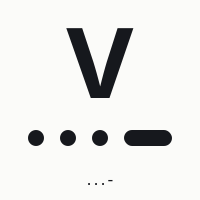
...-
- Said aloud
- di-di-di-dah
- Elements
- 4
Three shorts and a long: the most famous rhythm in the code.
V is di-di-di-dah, and it is the one Morse character a great many people can recognise without knowing they can. It is the opening of Beethoven’s Fifth Symphony, three short, one long, and the BBC used exactly that as its wartime station signature, because V stood for Victory and the rhythm was already in everyone’s ear.
It is a good demonstration of what this code actually is. Nobody hears those four notes as a count of three plus one; they hear a shape. That is precisely the perceptual shift a learner has to make across all thirty-six characters, and V is the one place where most people have already made it.
Structurally, V is S with one more element and B read backwards, which puts it in the middle of two different error types. The famous rhythm is the reason it rarely gets confused anyway.
V has a history the other letters lack. Its rhythm, three shorts and a long, matches the opening of Beethoven’s Fifth Symphony, and in the Second World War the BBC used those four notes as a station signature and the letter as a symbol: V for victory, tapped on walls and chalked on doors across occupied Europe. It is the one Morse character most people can name without having learned any Morse at all.
On the air V is a tuning letter. VVV sent repeatedly is a test transmission, the operator adjusting the transmitter before a real call, because the shape is easy to hear and easy to judge for timing. VY is very, as in VY FB, very fine business. In cut numbers V is 3, since 3 is di-di-di-dah-dah and V is one dash short of it. And it is B reversed, the pair worth drilling until the direction is a feeling.
Practise it in: V V V
How long it takes
At a given speed every character has a fixed length. V takes this long to send, gaps inside it included.
| 5 WPM | 2.16 s |
|---|---|
| 10 WPM | 1.08 s |
| 20 WPM | 0.54 s |
What it gets confused with
- V with its last element clipped is S:
...(S) - V with one element too many is 3:
...--(3) - V heard backwards is B:
-...(B)
Frequently asked
What is V in Morse code?
V is di-di-di-dah: three short signals and one long. Four elements, the reverse of B, and one element longer than S. Its rhythm is the opening of Beethoven’s Fifth Symphony.
Why is V for victory?
Because the letter’s rhythm, three shorts and a long, matches the four opening notes of Beethoven’s Fifth, which the BBC adopted as a signature during the Second World War. The letter became a symbol of resistance, sent as sound, tapped as rhythm, or drawn as a sign.
W in Morse Code

.--
- Said aloud
- di-dah-dah
- Elements
- 3
Short, long, long: the mirror of G, and one element from two more letters.
W is di-dah-dah. Reversed it is G; extended it is either P or J. Clipped it is A. That is four single-error neighbours for a three-element character, which is a lot, and all of them are common letters.
Density like this is the argument against learning characters in isolation. A W drilled alone feels solid and then fails the moment it appears next to a G in real text, because what you learned was the character and what you needed was the distinction.
The useful drill is W against G first, mirrors are the hardest, then W against A, P and J as a group.
W is the mirror of G and the first half of two of the most-used abbreviations: WX is weather, the thing every long contact eventually gets around to, and WPM is words per minute, the unit of Morse speed. WID is with, WL is will or well, and WKD is worked, as in WKD UR STN, I worked your station. The W callsign prefix belongs to the United States alongside K and N.
W sits in the middle of a run: A with a dash added, and one element short of J. A clipped W is heard as A, which is common and will usually be read as a word; an over-long W becomes J, which is rare and will usually be noticed. That asymmetry is a general truth about the alphabet: mistakes that land on common letters are the dangerous ones, because nothing flags them.
Practise it in: WG GW WA WP
How long it takes
At a given speed every character has a fixed length. W takes this long to send, gaps inside it included.
| 5 WPM | 2.16 s |
|---|---|
| 10 WPM | 1.08 s |
| 20 WPM | 0.54 s |
What it gets confused with
- W with its last element clipped is A:
.-(A) - W with one element too many is P:
.--.(P) - W with one element too many is J:
.---(J) - W heard backwards is G:
--.(G)
Frequently asked
What is W in Morse code?
W is di-dah-dah: one short signal and two long. Three elements, the reverse of G, and A with a dash on the end. J is W with a third dash.
What does WX mean in Morse code?
Weather. WX HR SUNNY is the weather here is sunny, and it comes up in nearly every relaxed contact. WPM, the other common W abbreviation, is words per minute, the measure of sending speed.
X in Morse Code
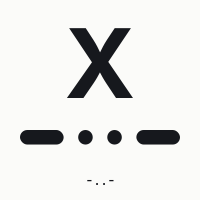
-..-
- Said aloud
- dah-di-di-dah
- Elements
- 4
Long, two shorts, long, symmetrical, and rarely sent.
X is dah-di-di-dah and reads the same backwards, which puts it in the small set of characters that cannot be confused with a mirror image. Its only single-element neighbour is D, reached by clipping the final dash.
X is rare in English text and correspondingly rare on the air, which means most learners meet it late and drill it less. That is usually fine, but it does mean X is often the character people are slowest on long after the rest of the alphabet is solid.
The symmetry makes it easier than its length suggests. Four elements with a stable shape and one neighbour is a gentler problem than three elements in a crowded neighbourhood, compare W.
X is a palindrome, dah-di-di-dah, symmetrical enough that heard backwards it is still X, and rare enough in English, about one letter in six hundred, that its four-element code costs almost nothing. It appears on the air mostly inside XYL, the operator’s wife, from ex-young-lady, a piece of old-fashioned humour that has outlived its era; XMTR is transmitter and XCVR is transceiver in the technical talk.
It is D with a dash on the end, and that is the mistake to watch for: a D sent with an accidental extra dash arrives as X, and since X is rare the receiver will usually notice. The letter’s own risk is a lost final dash, which makes D, a common letter that will be read without a second thought.
Practise it in: XD DX X
How long it takes
At a given speed every character has a fixed length. X takes this long to send, gaps inside it included.
| 5 WPM | 2.64 s |
|---|---|
| 10 WPM | 1.32 s |
| 20 WPM | 0.66 s |
What it gets confused with
- X with its last element clipped is D:
-..(D)
Frequently asked
What is X in Morse code?
X is dah-di-di-dah: long, short, short, long. Four elements, symmetrical, the same read forwards or backwards. It is D with a dash on the end.
What does XYL mean?
The operator’s wife, from ex-young-lady; YL is young lady, the form for a woman operator. The terms are old and are used with a smile; they date from a time when the hobby assumed its operators were men.
Y in Morse Code
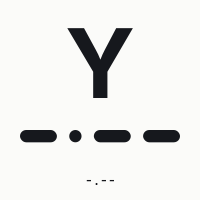
-.--
- Said aloud
- dah-di-dah-dah
- Elements
- 4
Long, short, long, long: the mirror of Q.
Y is dah-di-dah-dah, Q reversed. The pair is the last of the mirror pairs in the alphabet and one of the least drilled, because both letters are uncommon enough that beginners meet them late.
Y clips to K, which, as with C, L and R, means a lost final element produces a prosign, which nobody will read as a mistake. This keeps happening because K, R and the other short symmetrical codes are prefixes of longer letters by construction.
Take Y with Q and K together. Three characters, two error types, one drill.
Y is the mirror of Q and the second half of the pair that gives learners the most trouble among the four-element letters: both start with a dash, both have a single dot in the third position from one end, and the only difference is which end. Said aloud, Y falls at the finish, dah-di-dah-dah, and Q rises. Drill them together and the difference is obvious within a session.
YL is young lady, the form of address for a woman operator, and YR is year or your. Y is a middle-frequency letter in English, around sixteenth, and its code is K with a dash added: an over-long K becomes Y, which is one of the reasons the K that ends a transmission should be sent cleanly, since Y at the end of a message means nothing at all.
Practise it in: YQ QY YK
How long it takes
At a given speed every character has a fixed length. Y takes this long to send, gaps inside it included.
| 5 WPM | 3.12 s |
|---|---|
| 10 WPM | 1.56 s |
| 20 WPM | 0.78 s |
What it gets confused with
Frequently asked
What is Y in Morse code?
Y is dah-di-dah-dah: long, short, long, long. Four elements, the reverse of Q, and K with a dash on the end.
How do I tell Y from Q?
By which end the dot is near. Y has its dot second; Q has its dot third. Y ends heavily on two dashes; Q ends on one after a dip. Send them alternately, YQ QY, until the difference is a feeling.
Z in Morse Code
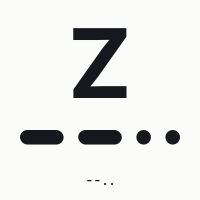
--..
- Said aloud
- dah-dah-di-dit
- Elements
- 4
Two longs and two shorts, rare, long, and one element from the digit 7.
Z is dah-dah-di-dit. Like J, it is a letter English barely uses that was given an expensive code on exactly that basis: the frequency logic that made E a single dot has to put the cost somewhere, and it put it on the letters nobody sends.
Z clips to G and extends to the digit 7. The second of those is the general pattern for digits, all ten are five elements, so each sits one element above some four-element letter, and a single hallucinated element turns a letter into a number.
It is worth noticing that this is a designed property and not an accident. The digits are uniform precisely so that they are never ambiguous with each other, and the cost of that uniformity is paid at the boundary with the letters.
Z is one of the rarest letters in English, under one in a thousand, and its code is long accordingly: G with a dot on the end. Its most common appearance on the air has nothing to do with words. Z is the suffix for Coordinated Universal Time, the zone every operator logs in: 1430Z is half past two in the afternoon UTC, whatever the local clock says, and it is the reason operators say zulu for the time.
Z closes the alphabet’s densest neighbourhood. It is one element from G, and G is one element from M, W and Q, so a mistake at any point in that cluster lands on a real letter. Because Z is rare and G is not, a receiver who hears something that might be either will read G unless the word insists on Z; that is context doing its work, and it is a tool, not a cheat.
Practise it in: Z7 7Z ZG
How long it takes
At a given speed every character has a fixed length. Z takes this long to send, gaps inside it included.
| 5 WPM | 2.64 s |
|---|---|
| 10 WPM | 1.32 s |
| 20 WPM | 0.66 s |
What it gets confused with
Frequently asked
What is Z in Morse code?
Z is dah-dah-di-dit: long, long, short, short. Four elements, G with a dot on the end. It is among the least frequent letters in English and has the long code to match.
What does Z mean after a time?
UTC, Coordinated Universal Time, the single clock every operator logs against. 0900Z is nine in the morning UTC regardless of local time. The letter is said as zulu, its NATO phonetic name.
0 in Morse Code
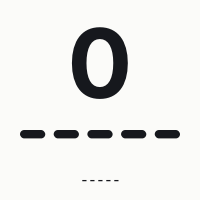
-----
- Said aloud
- dah-dah-dah-dah-dah
- Elements
- 5
Five dashes: the longest character in the code, and T when there is no time for it.
0 is five dashes, nineteen units long including the gaps inside it, the slowest character in the whole table. Its length is the price of the digit rule: every digit is five elements, the dashes fill from the left as the digits climb, and 0 is where they have filled everything. It is unmistakable at any speed, and it is slow.
That slowness is why contest operators replace it. In the cut-number system T stands for 0, so a serial number of 100 is sent 1TT and a signal report of 509 is 5T9. Some older operators send a single extra-long dash for zero instead, a habit inherited from American Morse; the international code has no such symbol, and this site does not send one.
How long it takes
At a given speed every character has a fixed length. 0 takes this long to send, gaps inside it included.
| 5 WPM | 4.56 s |
|---|---|
| 10 WPM | 2.28 s |
| 20 WPM | 1.14 s |
Frequently asked
What is 0 in Morse code?
0 is five dashes: dah-dah-dah-dah-dah. Five elements, all long, and the longest character in the code at nineteen units. It follows the digit rule: the dashes fill from the left as the digits climb from 5, and at 0 they have filled all five places.
1 in Morse Code
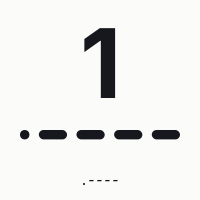
.----
- Said aloud
- di-dah-dah-dah-dah
- Elements
- 5
One dot and four dashes: the digit where the rule starts.
1 is a dot followed by four dashes, seventeen units long. The rule that generates all ten digits starts here: 1 has one dot at the left, 2 has two, 3 three, 4 four, and 5 is all dots. Then the dashes come back from the left, 6 through 9, until 0 is all dashes. Learn the rule and the digits need no memorising at all.
Digits turn up on the air in callsigns, where nearly every call has exactly one, in signal reports, in frequencies and in times, and 1 is in most of them. In cut numbers A stands for 1, since A is a dot and a dash and 1 is a dot and four; it is rarer than T for 0 or N for 9, but a contest operator will hear it.
How long it takes
At a given speed every character has a fixed length. 1 takes this long to send, gaps inside it included.
| 5 WPM | 4.08 s |
|---|---|
| 10 WPM | 2.04 s |
| 20 WPM | 1.02 s |
What it gets confused with
Frequently asked
What is 1 in Morse code?
1 is di-dah-dah-dah-dah: one short signal and four long. It is the first digit and the start of the rule: the number of dots at the left is the digit, up to 5.
2 in Morse Code
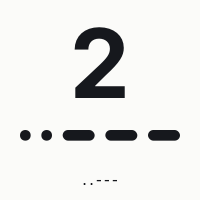
..---
- Said aloud
- di-di-dah-dah-dah
- Elements
- 5
Two dots and three dashes, and U with the tail lengthened.
2 is two dots and then three dashes, fifteen units. It is U, di-di-dah, with two more dashes on the end, which is the reason U is its cut number: a contest station sending 2 in a serial number may send U instead and expect to be understood.
The digits have mirror pairs of their own: 2 read backwards is 8, just as 1 is 9, 3 is 7 and 4 is 6, so direction matters here as much as it does for A and N. What a digit can also be mistaken for is the letter one element shorter, so 2 clipped is a U, and 2 is worth sending with all five elements sounded.
How long it takes
At a given speed every character has a fixed length. 2 takes this long to send, gaps inside it included.
| 5 WPM | 3.60 s |
|---|---|
| 10 WPM | 1.80 s |
| 20 WPM | 0.90 s |
What it gets confused with
- 2 heard backwards is 8:
---..(8)
Frequently asked
What is 2 in Morse code?
2 is di-di-dah-dah-dah: two short signals and three long. Five elements, the second digit, and U with two dashes added. In cut numbers U stands in for it.
3 in Morse Code
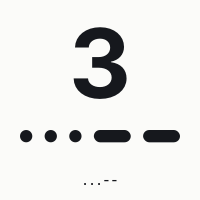
...--
- Said aloud
- di-di-di-dah-dah
- Elements
- 5
Three dots and two dashes: V with one dash more.
3 is three dots and two dashes, thirteen units. It is V with a dash added, and V is its cut number for that reason. The rhythm builds through three shorts and settles on two longs, which is easy to hear and easy to distinguish from 2 and 4 on either side, since the point where the dots stop is the whole information in the digit.
Signal reports use it constantly: the first digit of an RST report is readability from 1 to 5, and 3 is a readable-with-difficulty signal, honest and common. A 3 that arrives with a dot dropped is a 4 and with a dot added is a 2, and the receiving operator has no way to tell; the digits reward exact counts sent at a steady rhythm.
How long it takes
At a given speed every character has a fixed length. 3 takes this long to send, gaps inside it included.
| 5 WPM | 3.12 s |
|---|---|
| 10 WPM | 1.56 s |
| 20 WPM | 0.78 s |
What it gets confused with
Frequently asked
What is 3 in Morse code?
3 is di-di-di-dah-dah: three short signals and two long. Five elements, V with a dash on the end. In cut numbers V stands in for it.
4 in Morse Code
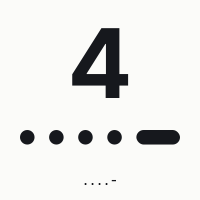
....-
- Said aloud
- di-di-di-di-dah
- Elements
- 5
Four dots and one dash, and one of the two digits with no cut number.
4 is four dots and a dash, eleven units. It is H with a dash on the end, and the digit whose dots most tempt a learner to count: four fast dots and then a dash is a burst that has to be heard as a shape, the same lesson H teaches one element earlier.
It has no cut number, and neither does 6. T, A, U, V, E, B, D and N stand in for the other eight digits, and 4 is sent as itself, because the convention never settled on a letter for it and the digit is short enough not to need one. It is a good digit to start on for exactly that reason: what you learn is the digit itself and not a substitute.
How long it takes
At a given speed every character has a fixed length. 4 takes this long to send, gaps inside it included.
| 5 WPM | 2.64 s |
|---|---|
| 10 WPM | 1.32 s |
| 20 WPM | 0.66 s |
What it gets confused with
Frequently asked
What is 4 in Morse code?
4 is di-di-di-di-dah: four short signals and one long. Five elements, H with a dash on the end. With 6, it is one of the two digits with no cut-number substitute.
5 in Morse Code
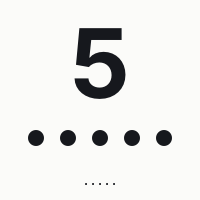
.....
- Said aloud
- di-di-di-di-dit
- Elements
- 5
Five dots: the turn of the rule, and E in a hurry.
5 is five dots, nine units, the shortest digit and the middle of the rule: the dots have filled every place, and from 6 onward the dashes come back in from the left. It is H with a fifth dot, the last step of the dot chain that runs E, I, S, H, 5, and it is the digit where counting finally becomes impossible at any working speed.
In cut numbers E stands for 5, so 5NN, the 599 report, sometimes arrives as ENN. It leads most signal reports, since 5 is the top readability score and nearly every report given is a 5 of something. A 5 with a dot lost is a 4; a receiver who hears four fast dots followed by nothing has to decide, and the sender’s steady rhythm is what makes the decision possible.
How long it takes
At a given speed every character has a fixed length. 5 takes this long to send, gaps inside it included.
| 5 WPM | 2.16 s |
|---|---|
| 10 WPM | 1.08 s |
| 20 WPM | 0.54 s |
What it gets confused with
- 5 with its last element clipped is H:
....(H)
Frequently asked
What is 5 in Morse code?
5 is five dots: di-di-di-di-dit. Five elements, all short, the shortest digit at nine units. It is where the digit rule turns: below it the dots grow from the left, above it the dashes take over from the left.
6 in Morse Code
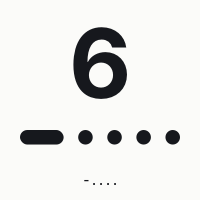
-....
- Said aloud
- dah-di-di-di-dit
- Elements
- 5
One dash and four dots: the dashes come back.
6 is a dash and four dots, eleven units. It is the first digit on the far side of the rule: the dots have filled all five places at 5, and now the dashes replace them from the left, one per digit, until 0. It is B with a dot on the end, and B is one element short of it in the same way that H is one short of 5.
6 has no cut number of its own; it is sent as itself. Its risk is the lost final dot that turns it into B, and B inside a number will be read as a 7 by a receiver who knows cut numbers, so a 6 sent lazily can arrive as the wrong digit rather than as an obvious error.
How long it takes
At a given speed every character has a fixed length. 6 takes this long to send, gaps inside it included.
| 5 WPM | 2.64 s |
|---|---|
| 10 WPM | 1.32 s |
| 20 WPM | 0.66 s |
What it gets confused with
Frequently asked
What is 6 in Morse code?
6 is dah-di-di-di-dit: one long signal and four short. Five elements, B with a dot on the end. It is the first digit where the dashes start replacing the dots from the left.
7 in Morse Code
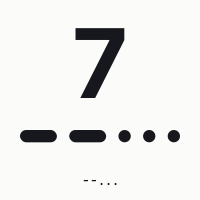
--...
- Said aloud
- dah-dah-di-di-dit
- Elements
- 5
Two dashes and three dots, and B when the operator is in a hurry.
7 is two dashes and three dots, thirteen units. B is its cut number, because B is dah-di-di-dit and 7 is the same run with a second dash at the front; a 5B7 in a contest exchange is 577. It is also Z with a dot on the end, and Z is one element short of it.
The digits from 6 to 9 mirror the digits from 4 down to 1 with the elements swapped, and 7 is the counterpart of 3: three of one element and two of the other. Hearing that symmetry helps; a learner who has 3 solid finds 7 comes quickly, because the rhythm is the same weight the other way round.
How long it takes
At a given speed every character has a fixed length. 7 takes this long to send, gaps inside it included.
| 5 WPM | 3.12 s |
|---|---|
| 10 WPM | 1.56 s |
| 20 WPM | 0.78 s |
What it gets confused with
Frequently asked
What is 7 in Morse code?
7 is dah-dah-di-di-dit: two long signals and three short. Five elements, Z with a dot on the end. In cut numbers B stands in for it.
8 in Morse Code
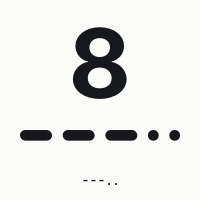
---..
- Said aloud
- dah-dah-dah-di-dit
- Elements
- 5
Three dashes and two dots, the mirror-weight of 2.
8 is three dashes and two dots, fifteen units, the counterpart of 2 with the elements swapped. D is its cut number: D is dah-di-dit, and 8 is the same run with two more dashes at the front, so a contest station sending 588 may send 5DD.
Like every digit it is five elements, and the only information in it is where the dashes stop. A dash too few makes 7, one too many makes 9, and the receiver cannot tell an honest 8 from a mis-sent neighbour; steady rhythm is the whole defence. 8 turns up in signal reports as a strength score, a strong signal, and in the 88 that closes a contact between friends: love and kisses, the affectionate cousin of 73.
How long it takes
At a given speed every character has a fixed length. 8 takes this long to send, gaps inside it included.
| 5 WPM | 3.60 s |
|---|---|
| 10 WPM | 1.80 s |
| 20 WPM | 0.90 s |
What it gets confused with
- 8 heard backwards is 2:
..---(2)
Frequently asked
What is 8 in Morse code?
8 is dah-dah-dah-di-dit: three long signals and two short. Five elements, the counterpart of 2 with the elements swapped. In cut numbers D stands in for it.
9 in Morse Code
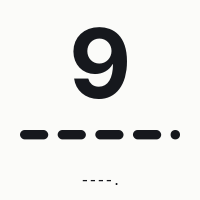
----.
- Said aloud
- dah-dah-dah-dah-dit
- Elements
- 5
Four dashes and a dot, and N in nearly every contest exchange.
9 is four dashes and one dot, seventeen units, which with 1 makes it the second longest character in the code. N is its cut number, since N is dah-dit and 9 is the same run with three more dashes at the front, and it is the most-heard cut number of all: 5NN, the 599 report, is sent thousands of times in a contest weekend and almost never as full digits.
It is the counterpart of 1 with the elements swapped, four of one and one of the other. In an RST report the 9 is the top strength and the top tone score, so 599 is the best report there is, and the fact that operators send it as 5NN regardless of the actual signal is one of the hobby’s quiet jokes.
How long it takes
At a given speed every character has a fixed length. 9 takes this long to send, gaps inside it included.
| 5 WPM | 4.08 s |
|---|---|
| 10 WPM | 2.04 s |
| 20 WPM | 1.02 s |
What it gets confused with
- 9 heard backwards is 1:
.----(1)
Frequently asked
What is 9 in Morse code?
9 is dah-dah-dah-dah-dit: four long signals and one short. Five elements, seventeen units, the counterpart of 1 with the elements swapped. In cut numbers N stands in for it, which is why 599 is sent as 5NN.
A note on the exclamation mark
You will find a code for ! on many Morse code charts. It is not in the standard. It is a convention outside the Recommendation, one the ITU has never adopted, so this site does not send it: if you type one, it is left in the output, never quietly turned into something else. The same goes for any other mark a chart offers that the table above does not: a code that is not in the Recommendation is a code two operators may read differently, and the whole value of a standard is that they cannot.
Frequently asked
How many characters are in the Morse code alphabet?
Twenty-six letters, ten digits and thirteen punctuation marks with a code of their own are defined by ITU-R M.1677-1, forty-nine in total (the multiplication sign is also listed, sent as X). The Recommendation adds one accented letter, É, and six procedural signals, which are not letters at all but instructions. A few more accented letters come from older international tables and are shown separately below.
Why are some letters so much shorter than others?
Because the codes were assigned by how often letters appear in English. E is a single dot and T a single dash; Q and Y take four elements each. The story is that Alfred Vail counted the type in a printer’s case to find out which letters were used most. It is why Morse is faster to send than a fixed-length code would be, and the whole reason the alphabet looks irregular.
Is there a printable Morse code chart?
Yes: the chart at the top of this page is generated from the same code table the translator uses, so it cannot be wrong where the tool is right. Print the page, or use the tables directly; every character is here in one place.
Is there an exclamation mark?
Not in the standard. You will find a code for it on many charts, and more than one: a convention outside the Recommendation, which the ITU has never adopted. This site does not send it: if you type one it is left in the output, never quietly turned into something else.
What is the fastest way to learn it?
Not this chart. A chart teaches you to look characters up, which is a different skill from hearing them. The Koch method starts with two characters at full speed and adds a third only once the first two are reliable; the letters below are grouped by length for the same reason. Learn the sound, never the picture.
Do accented letters have codes?
A few. ITU-R M.1677-1 itself defines only É. The codes for À, Ä, Ç, È, Ñ, Ö, Ü come from older international tables and are still in use, so this site sends them; the digraph CH is sent only on the Czech version of the site. The accented vowels common in Portuguese (á, â, ã, ê, í, ó, ô, õ, ú) are sent as their base letter, as a receiving operator expects; anything else is left in the output and named.